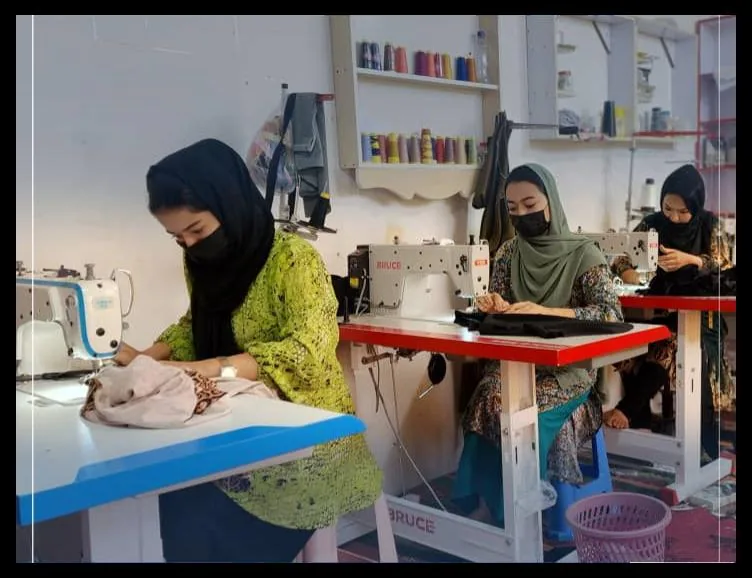
Three Afghan women sit at industrial sewing machines in a fully equipped workshop — heads down, focused, producing. This is what economic empowerment looks like the day after the ceremony: women at work, earning, and building something of their own.
Daily Operations: A Women Tailoring Workshop in Action
Inside Gate of Hope's women tailoring workshop in action, three Afghan women sit at industrial sewing machines, surrounded by walls neatly lined with spools of colourful thread. The conclusion of distribution ceremonies and certificate handovers marks the true beginning of sustained daily activity inside our program spaces. Each woman works intently on the fabric before her, focused on turning raw textiles into completed, market-ready garments. This working environment demonstrates a practical model of economic engagement, where participants transition immediately from initial training into daily technical application and tangible skill development.
Rather than treating participants as passive recipients of emergency aid, the workshop structure recognizes them as active, skilled professionals. The facility opens daily, allowing women to arrive, take their assigned stations, and immediately begin their tailored sewing assignments. Some participants join the workshop to learn foundational garment construction, while others enter with existing tailoring experience but previously lacked access to heavy-duty industrial machinery and secure physical workspace. Gate of Hope provides both the essential physical infrastructure and high-grade equipment necessary for consistent daily work.
The practical focus of the workshop encompasses a wide range of tailoring activities, including full garment creation, custom clothing orders, and detailed fabric alterations. By maintaining a well-stocked and effectively managed facility, the program aims to ensure that women have a reliable location where they can exercise their technical skills continuously without supply shortages. Establishing long-term operational consistency ensures that workshop participants can depend on a stable, safe working environment every single morning.
Addressing Economic Constraints Through Vocational Infrastructure
Gate of Hope structures its vocational initiatives on the principle that long-term community resilience requires sustained physical resources and accessible facilities. Beyond providing initial instruction, the organization maintains physical workshop spaces to ensure that a lack of tools does not prevent skilled individuals from pursuing commercial work. Aligning ongoing vocational training with functional equipment directly addresses key supply-side barriers in local employment creation and skill maintenance.
Socioeconomic Context in Afghanistan
Efforts to establish sustainable livelihoods for Afghan women occur within a remarkably constrained economic environment across the region. According to official socio-economic reports from the United Nations Development Programme (UNDP), female employment outside the household has stagnated at approximately 6 to 7 percent nationwide. Furthermore, UN Women documentation highlights severe systemic barriers that severely limit formal economic opportunities for women, increasing household economic vulnerability and forcing families to rely on limited coping mechanisms.
In light of these nationwide challenges, community-based vocational initiatives offer a crucial practical pathway for skill utilization and household support. Industrial sewing equipment allows women to produce higher volumes of durable garments and perform complex alterations that standard home sewing machines cannot handle. By targeting local demand for tailored clothing and practical fabric repairs, workshop programs seek to create structured earning potential within existing community markets, providing a reliable foundation for household stability.
Practical Logistics, Equipment Upkeep, and Workshop Management
Facility management also involves organizing the workshop space effectively to accommodate participants with varying levels of experience. Workshop supervisors facilitate structured daily schedules, allowing experienced tailors to offer practical guidance and mentorship to newer participants refining their techniques. Regular monitoring and clear accountability measures ensure that the physical facility remains safe, properly lit, well-ventilated, and systematically organized to support productive, dignified daily work.
Maintaining Operational Reliability
Running an active tailoring facility requires continuous logistical oversight, structural planning, and preventive equipment maintenance. Industrial sewing machines feature specialized mechanical components, drive belts, and needle assemblies that experience significant mechanical wear under continuous daily operation. Program management teams arrange regular technical checks, oiling, and routine part replacements to prevent machine downtime and ensure safe operating conditions for all active workshop participants.
In addition to machine maintenance, active supply chain management plays a vital role in maintaining daily facility operations. Workshop coordinators closely track inventory for consumable supplies, ensuring that spools of thread across various color specifications, heavy-duty shears, measuring tapes, tailoring chalk, and pattern fabrics remain fully stocked. Maintaining continuous access to basic working supplies prevents operational delays and allows participants to maintain steady daily production workflows without unexpected stoppage.
Sustaining Long-Term Vocational Programs for Afghan Women
Every hour spent operating industrial machinery inside the workshop allows participants to refine technical skills and engage in structured economic productivity. Gate of Hope focuses on building vocational programs designed to endure far beyond temporary relief measures, providing sustained operational environments where Afghan women can consistently practice their trade. A long-term organizational commitment to maintaining these facilities helps foster practical skill retention, personal agency, and broader community stability over time.
To ensure the ongoing operation of these vocational spaces, financial contributions are pooled across Gate of Hope's broader humanitarian and development initiatives. Donated funds support total operational requirements, including equipment procurement, ongoing mechanical maintenance, facility rental costs, raw material supplies, and local supervisory coordination. Contributions are allocated dynamically to address pressing operational needs across relevant projects, rather than guaranteeing specific individual items or fixed individual financial outcomes.
Supporting these initiatives helps preserve vital community infrastructure, ensuring that workshop spaces remain open, fully equipped, and operationally sound. Your financial engagement enables Gate of Hope to maintain structured vocational environments where Afghan women can work with dignity every day. Together, we can sustain practical, measurable programs that provide long-term vocational opportunities and tangible hope across Afghan communities.
Ways to contribute
All gifts are pooled across the supplies, training, delivery, equipment, follow-up, and maintenance needed to run this work responsibly.
Examples describe pooled program support; they do not guarantee that a specific gift purchases a specific item or produces a fixed result.