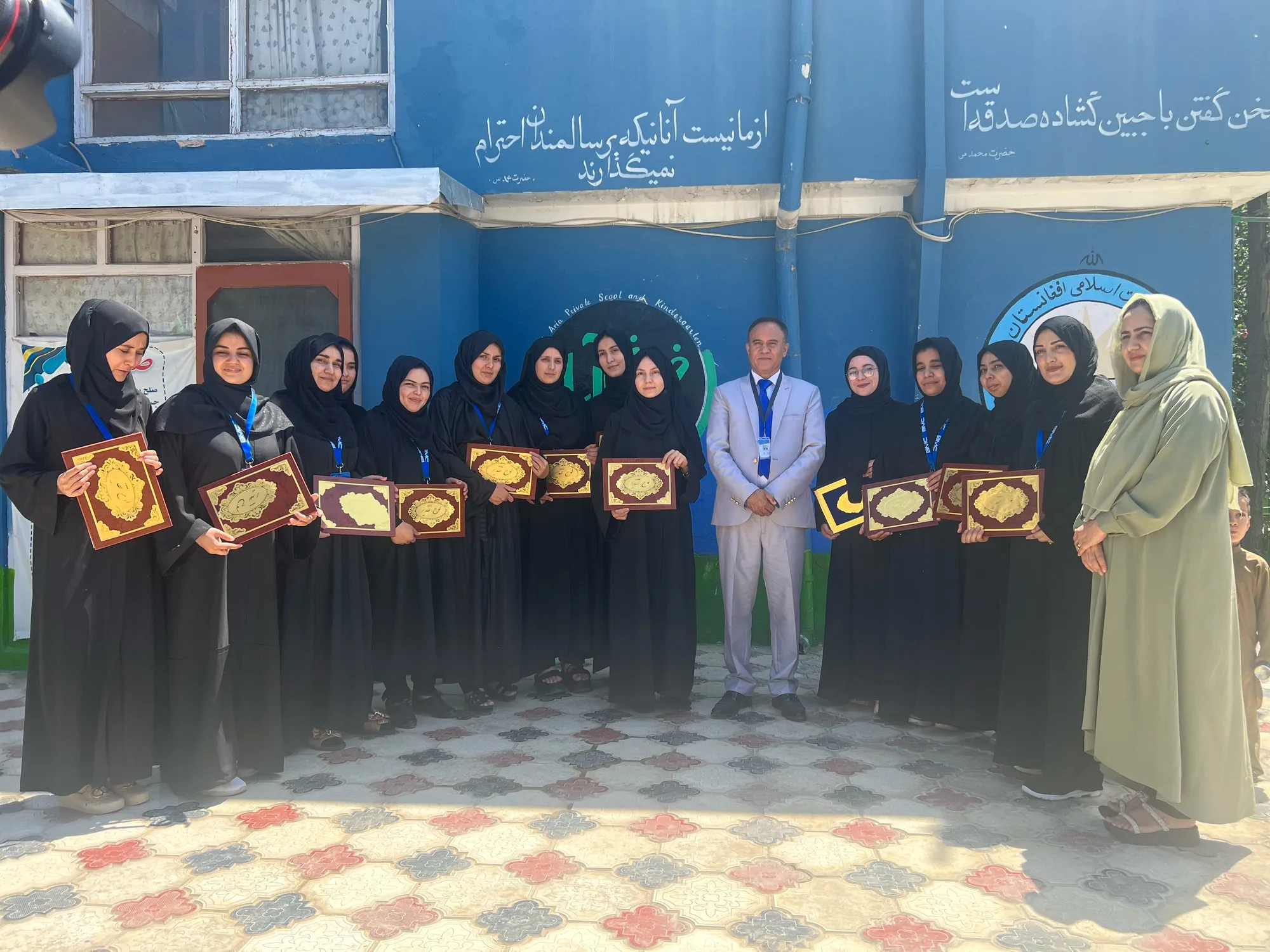
A row of Afghan women stood proudly outside their school holding decorated certificates — the formal result of months of dedicated study and the visible proof that Gate of Hope's investment in women's education delivers real, lasting outcomes.
Celebrating Afghan Women at Graduation Ceremony
Outside a local school building, a row of Afghan women recently stood side by side holding decorated certificates and commemorative plaques alongside a Gate of Hope representative. This formal gathering marked a graduation ceremony, celebrating the completion of structured educational coursework and skill-building modules. In a national environment where educational access for women faces deep structural barriers and policy constraints, displaying earned credentials outside their learning facility represents a significant milestone of personal dedication and community perseverance.
The certificates and plaques held by these graduates represent far more than formal paperwork. They are tangible symbols of acquired knowledge, spent effort, and completed modules—achievements that remain permanently with each individual. For the women participating in these courses, showing up consistently, completing assignments, and earning formal recognition reflects quiet defiance and immense personal determination amidst widespread structural uncertainty. Gate of Hope structures its programs so that learning leads to tangible qualifications rather than informal participation alone.
Earned Credentials in a Restricted Environment
The broader socio-economic reality for women in Afghanistan presents severe obstacles to personal advancement and formal economic participation. According to United Nations Development Programme (UNDP) analysis, female employment outside the household has stagnated at approximately 6 to 7 percent in recent years, while access to formal secondary and higher education remains heavily restricted. In this challenging landscape, community-based educational initiatives provide crucial pathways for women to acquire practical skills, maintain intellectual engagement, and foster supportive social networks within approved local frameworks.
Contextual Realities Facing Female Education in Afghanistan
Reports from UNESCO and UNICEF highlight a staggering national educational crisis across Afghanistan, where millions of primary and secondary school-aged children remain out of school. Girls represent the overwhelming majority of those deprived of formal secondary education, compounding a generational loss of learning opportunities. Additionally, severe infrastructure deficits affect educational spaces across the country, with many facilities lacking basic sanitation, reliable electricity, or protective perimeter walls, which further hinders consistent attendance for young women.
In response to these vast systemic hurdles, community-oriented educational programs aim to bridge critical learning gaps by providing safe, supportive, and dignified environments. Gate of Hope structures its educational offerings specifically around defined completion goals. Rather than conducting ad-hoc activities without measurable outcomes, programs are built with structured curricula designed to guide students toward a clear graduation event, ensuring that every hour spent studying earns recognizable validation.
Organizing formal graduation ceremonies serves an essential function within local communities. Publicly presenting certificates in the presence of peers and organizational representatives signals to families, local leaders, and the graduates themselves that female education possesses undeniable social and practical value. Celebrating these accomplishments builds local acceptance and reinforces the understanding that women's skills are essential assets for family well-being and broader community development over time.
Practical Delivery, Logistics, and Program Verification
Delivering structured education courses and coordinating graduation ceremonies requires intricate operational planning and steady local engagement. Gate of Hope field personnel oversee the procurement and distribution of instructional materials, maintain suitable learning spaces, print formal certificates, and organize secure transit arrangements for participants. Successfully managing these activities depends on maintaining open communication with local community elders to ensure safe, continuous access for all enrolled women throughout their full study period.
Verification and Institutional Accountability
Holding a formal ceremony serves as an essential monitoring mechanism within Gate of Hope’s operating framework. Presenting physical certificates and plaques ensures that participants have met established attendance criteria and completed all required course modules prior to graduation. This structured approach provides verifiable proof to program managers and financial supporters that educational resources directly translate into completed training cohorts and documented learning milestones.
Photographs and records from graduation events offer clear evidence of completed program activities without relying on unverified assumptions regarding long-term socio-economic outcomes. While future employment opportunities depend heavily on broader economic conditions and national policies, documenting these ceremonies confirms that project objectives were fully achieved and that participants successfully earned their formal qualifications. Maintaining these operational records ensures accountability to both community members and global contributors.
Sustaining Hope and Investing in Afghan Women
Gate of Hope remains dedicated to expanding and sustaining flexible learning opportunities for Afghan women. Earning a graduation certificate represents both a personal triumph over circumstance and an essential baseline for future initiatives, whether in informal enterprise, home-based production, or further community involvement. Maintaining these pathways requires persistent organizational commitment and steady resource allocation to adapt to evolving local requirements while respecting participant safety and community dignity.
Financial contributions from donors and international supporters directly enable the continuation of these educational efforts. Contributions are pooled into program funds to cover learning space maintenance, textbook printing, certificate production, instructor stipends, and program coordination. For instance, a $10 gift contributes toward pooled funds for essential student learning supplies and printed educational workbooks. A $15 donation supports pooled resources for certificate printing, framing supplies, and recognition materials. A $25 contribution aids pooled funding for instructor training, curriculum distribution, and facility upkeep. A $50 gift helps support pooled logistical costs, safe transport arrangements, and ongoing program monitoring.
Looking forward, Gate of Hope continues to prioritize programs that uphold the dignity, rights, and potential of Afghan women. Every completed course and graduation ceremony provides visible evidence that Afghan women remain eager to learn, grow, and build better futures for themselves and their families when given the opportunity and support to succeed. We invite supporters worldwide to partner with us in making these educational milestones possible.
Ways to contribute
All gifts are pooled across the supplies, training, delivery, equipment, follow-up, and maintenance needed to run this work responsibly.
Examples describe pooled program support; they do not guarantee that a specific gift purchases a specific item or produces a fixed result.