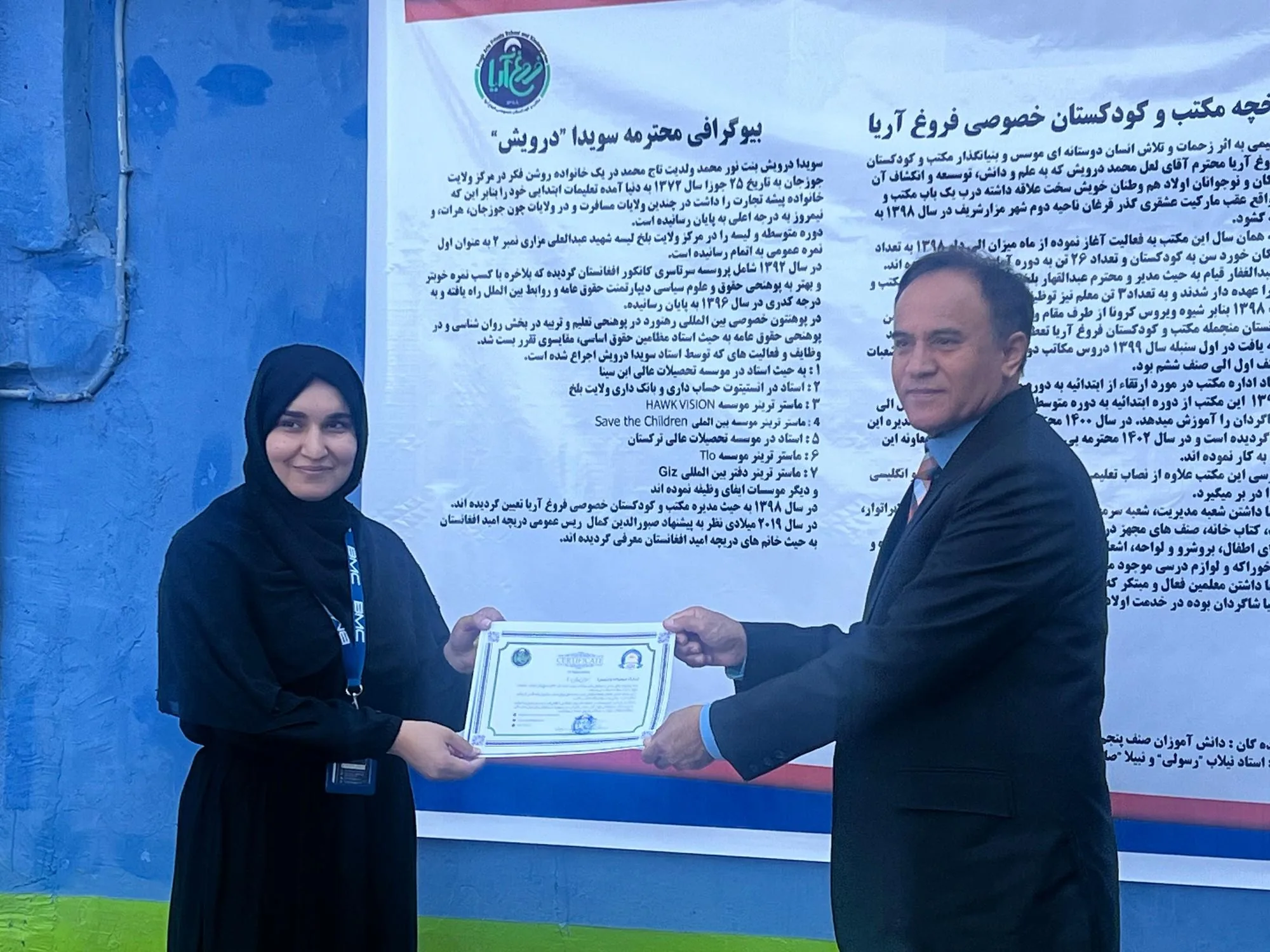
Standing before a hall of community achievements, a young Afghan woman received her certificate directly from a senior Gate of Hope representative — a formal act of recognition that affirms her work, her skills, and her place in Afghanistan's future.
Formal Recognition for Afghan Women at Official Award Ceremony
In a formal ceremony setting, framed by display boards highlighting the biographies and community achievements of local citizens, a young Afghan woman stepped forward to receive her official completion certificate. The formal handover was conducted directly by a senior representative of Gate of Hope. Designed with formal attire, structured presentation protocols, and designated community observers, the gathering provided a dignified space to honour her sustained efforts, validate her technical skills, and affirm her vital place within Afghanistan's collective future.
Public recognition carries substantial social and cultural weight within Afghan communities. In local contexts where individual accomplishments require collective validation, presenting an official certificate from an established organization signals that a participant's hard work has been systematically evaluated and found worthy of professional credit. This formal validation extends far beyond the individual recipient, offering clear and visible evidence to families, peers, and village elders that women's technical contributions possess legitimate, documentable value in public life.
Rather than issuing informal tokens of attendance, the event was meticulously organized to mirror traditional professional accreditation ceremonies. Biography boards positioned throughout the hall detailed specific learning milestones and practical achievements, ensuring that each certificate represented earned qualifications. The formal atmosphere reflected Gate of Hope's standing commitment to treating the educational and vocational accomplishments of Afghan women with genuine seriousness, dignity, and administrative rigor.
National Context and the Economic Landscape for Afghan Women
The profound importance of formal award ceremonies becomes clearer when evaluated against Afghanistan's challenging socio-economic landscape. According to reporting by the United Nations Development Programme, female employment outside the household has stagnated at approximately 6 to 7 percent, while broader policy restrictions continue to restrict access to formal secondary education and professional workplaces across the country. In an environment where systemic barriers frequently obscure female contributions, official documentation provides a crucial permanent record of individual competence and active civic engagement.
Navigating Structural Barriers to Skills Recognition
Independent research from international monitoring bodies, including UN Women and UNICEF, highlights how restricted institutional access limits female economic self-reliance and household resilience. When secondary and higher education pathways remain constrained, community-based vocational training programs and verified local certification initiatives serve as indispensable mechanisms for maintaining essential human capital, preserving technical knowledge, and fostering self-sufficiency across both urban centers and isolated rural communities.
By establishing secure and structured platforms where women are systematically trained, evaluated according to strict criteria, and publicly recognized, non-profit initiatives help counter the systematic erasure of female achievement from public memory. Creating an official administrative paper trail for completed training supports individual self-worth while ensuring that valuable skill sets remain recognized and available for future community recovery efforts.
Delivery Logistics and Institutional Standards
Organizing a dignified award ceremony requires extensive planning, robust background logistics, and careful community coordination. Prior to any formal presentation event, comprehensive training modules are delivered over multi-week instructional cycles. Technical instructors track attendance, conduct continuous practical assessments, and evaluate final competency demonstrations. Consequently, every certificate handed over represents documented hours of coursework, practical skill application, and demonstrated mastery rather than mere event attendance.
Rigorous Training Pathways and Operational Standards
Practical event preparation involves securing appropriate and safe community spaces, printing detailed biography displays, arranging transport logistics for participants and instructors, and engaging in open communication with local leadership structures. By adhering to rigorous organizational standards, Gate of Hope ensures operational integrity while maintaining full compliance with local cultural parameters, strict safety guidelines, and participant privacy protocols.
The human significance of these proceedings lies in the quiet restoration of personal agency, dignity, and public standing. Standing before peers, relatives, and local leaders to receive a physical credential offers participants concrete proof of their capabilities without relying on dramatic or patronizing narratives. These formal ceremonies act as an essential bridge between introductory skills acquisition and real-world application, supplying women with recognized documentation to support future economic endeavors or community initiatives.
Sustaining Impact, Accountability, and How to Support
Thorough operational reporting and ongoing outcome monitoring are essential elements of Gate of Hope's organizational accountability. Following each award ceremony, specialized field monitoring teams follow up with certificate recipients to evaluate how newly acquired skills are being applied within their households, informal work settings, and immediate local networks. These systematic monitoring activities provide clear feedback on curriculum effectiveness, help identify necessary program refinements, and verify that community interventions yield practical, lasting benefits.
Sustaining and expanding these structured training pathways across underserved regions requires steady financial resources across all operational stages. Financial gifts from donors are not assigned to single individual certificates or specific named participants; instead, all donations are pooled directly into Gate of Hope's central program funds. This pooled funding approach covers critical operational expenses, including curriculum development, teaching materials, instructor compensation, transport and delivery logistics for field staff, secure venue rentals, equipment maintenance, and long-term monitoring visits.
Every contribution strengthens our collective capacity to deliver high-quality, dignified education and training initiatives across Afghanistan. An urgent invitation is extended to individuals, community partners, and donor institutions to join this pooled effort, ensuring that Afghan women continue to receive the rigorous training, formal credentials, and sustained institutional support necessary to achieve recognition and build resilient futures.
Ways to contribute
All gifts are pooled across the supplies, training, delivery, equipment, follow-up, and maintenance needed to run this work responsibly.
Examples describe pooled program support; they do not guarantee that a specific gift purchases a specific item or produces a fixed result.