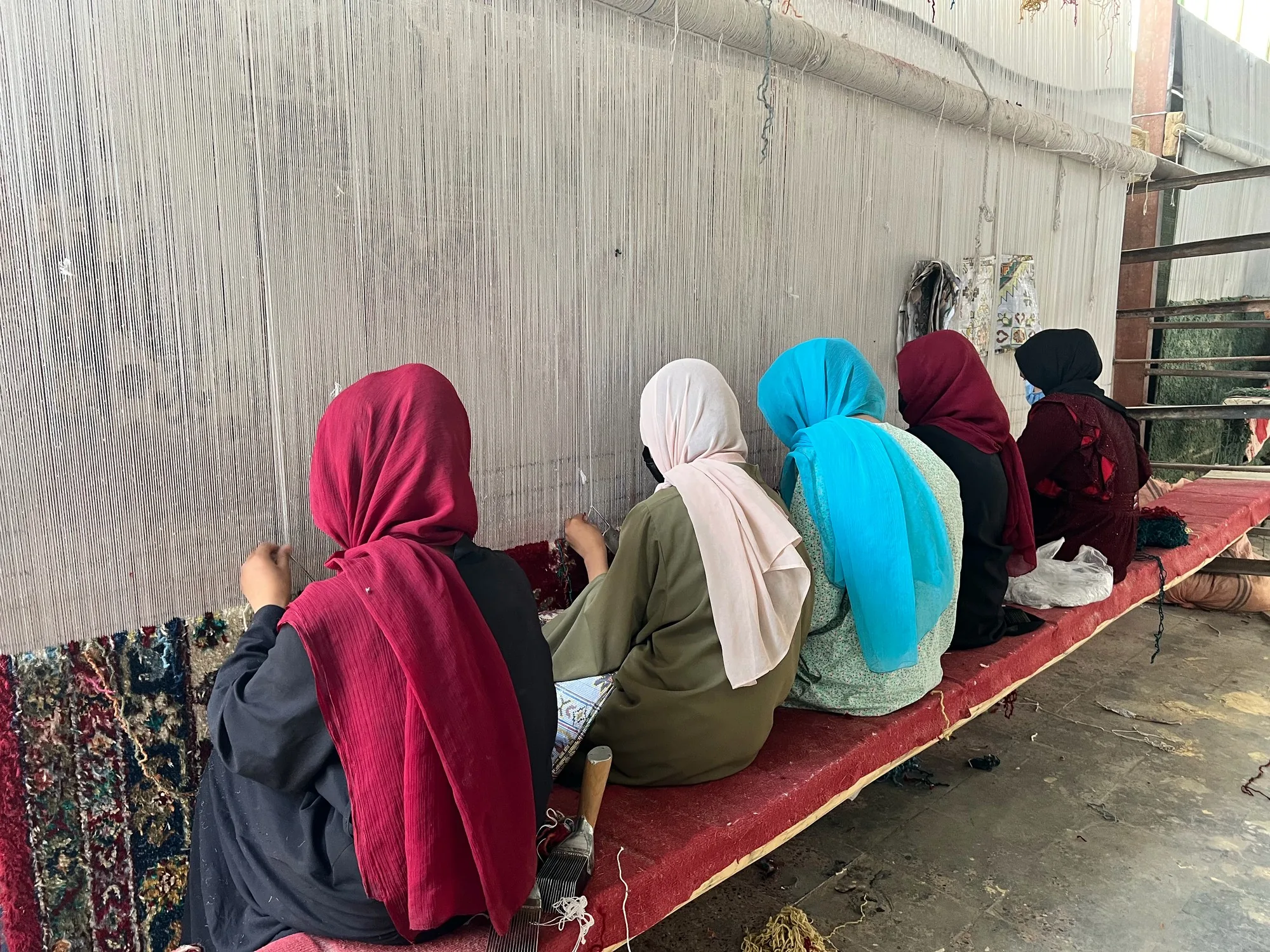
Side by side at a large wooden loom, a group of Afghan women weave intricate carpets — each knot a thread of income, independence, and cultural pride preserved through Gate of Hope's crafts program.
Preserving Heritage and Livelihoods: Afghan Women Revive Traditional Carpet Weaving Crafts
At a large traditional wooden loom supported by Gate of Hope, a group of Afghan women sit side by side, working rhythmically to tie thousands of individual knots into intricate carpets featuring traditional geometric patterns and heritage motifs. Hand-knotted carpet weaving represents one of Afghanistan’s most globally celebrated cultural arts, a master craft refined over centuries and passed down through generations of artisans. Through Gate of Hope’s dedicated craft initiative, women come together in an organized, supportive workspace to practice this traditional artform, transforming generational expertise into structured economic participation.
The project’s primary objective is to bridge the long-standing gap between skilled Afghan craftswomen and sustainable income opportunities. Although many women across local communities possess extraordinary technical weaving abilities, they frequently lack access to high-quality raw materials, dedicated working facilities, and reliable market connections. Gate of Hope addresses these systemic barriers by supplying premium wool and silk yarns, constructing and maintaining heavy wooden looms, establishing organized workshop environments, and facilitating practical pathways to prospective buyers. By creating these essential operational foundations, the initiative seeks to ensure that intricate hand-woven carpets can reach viable markets, generating much-needed earnings for participating households while safeguarding Afghanistan's rich cultural heritage knot by knot.
Livelihood Realities and the Broader Afghan Context
To fully understand the urgency and significance of initiatives where Afghan women revive traditional carpet weaving crafts, one must examine the severe economic landscape facing women across the country today. Over recent years, structural constraints have drastically restricted women’s participation in public life, access to formal education, and formal employment, creating unprecedented hardships for families striving to secure daily food and basic necessities.
Economic Constraints and Stagnant Female Employment
Comprehensive socio-economic data from international monitoring agencies highlights the full scale of these challenges. According to documented findings in the UNDP Afghanistan Socio-Economic Review, female employment outside the household has stagnated at roughly 6 to 7 percent. Furthermore, assessments released by UN Women emphasize that Afghan women face severe social, economic, and institutional barriers that restrict their potential contributions to the national workforce. In a society where formal office or institutional jobs are largely inaccessible to women, organized craft production within safe, community-aligned settings provides one of the few functional pathways for legitimate livelihood generation.
Cultural Heritage as a Pillar of Community Autonomy
Beyond immediate financial support, traditional carpet weaving provides vital social and psychological stability. Gathering daily around a shared loom creates an interactive environment where women connect, exchange complex weaving techniques, and support one another through shared challenges. In a context marked by widespread social isolation, this collaborative workspace fosters personal dignity, self-reliance, and strong community solidarity. Preserving this centuries-old craft ensures that Afghanistan's artistic heritage remains vibrant, while offering participating craftswomen a renewed sense of purpose, identity, and shared strength.
Practical Delivery, Workshop Operations, and Program Accountability
Translating traditional craft preservation into practical economic opportunity demands meticulous planning, logistics coordination, and rigorous program accountability. Gate of Hope manages the complete operational supply chain for the weaving initiative, beginning with the responsible procurement of high-grade raw materials—including natural hand-spun sheep wool, vibrant dyed silk threads, strong cotton warp yarns, and essential hand tools such as heavy iron combs, weaving beaters, and curved carpet shears. Sourcing quality materials locally helps sustain regional supply networks while ensuring weavers work with durable fibers.
Establishing safe, well-ventilated, and adequately lit workshop locations ensures that weavers can work productively under safe physical conditions. Field staff and community coordinators conduct systematic monitoring visits to inspect loom structural safety, verify knot density and pattern consistency, oversee material distribution, and assist with transport logistics when finished carpets are ready for market evaluation. However, operating humanitarian and craft programs in Afghanistan involves navigating significant contextual obstacles. Unpredictable inflation in material prices, transport delays, regional market instability, and regulatory shifts require constant operational adjustments. Gate of Hope maintains clear project tracking, recognizing that while weaving programs offer meaningful economic potential, sustainable impact depends on ongoing loom upkeep, careful material management, and persistent follow-up.
Sustaining Afghan Artisans Through Collective Action
Protecting historic craftsmanship and building viable economic opportunities for Afghan women requires sustained international support and steady resource allocation. Supporting craftswomen so they can maintain their workshop spaces, acquire bulk weaving supplies, and navigate complex market channels depends on continuous community-backed backing across every stage of program implementation. Without consistent support, even highly skilled artisans face immense hurdles maintaining continuous production.
All donations to Gate of Hope are pooled across active program initiatives to maximize operational flexibility and direct impact where needed most. Rather than funding isolated purchases or promising guaranteed economic outcomes, gifts of $10, $15, $25, or $50 contribute toward overall program resources. These pooled funds support the procurement of bulk raw materials, repair and maintenance of traditional wooden looms, transportation of raw inputs and finished goods, specialized training sessions, and continuous site monitoring. Every contribution strengthens Gate of Hope’s overall capacity to stand alongside Afghan craftswomen as they preserve their cultural heritage, sharpen their technical skills, and work toward sustainable economic security. We urgently invite donors worldwide to support these resilient weavers and invest in the future of Afghan craft traditions.
Ways to contribute
All gifts are pooled across the supplies, training, delivery, equipment, follow-up, and maintenance needed to run this work responsibly.
Examples describe pooled program support; they do not guarantee that a specific gift purchases a specific item or produces a fixed result.