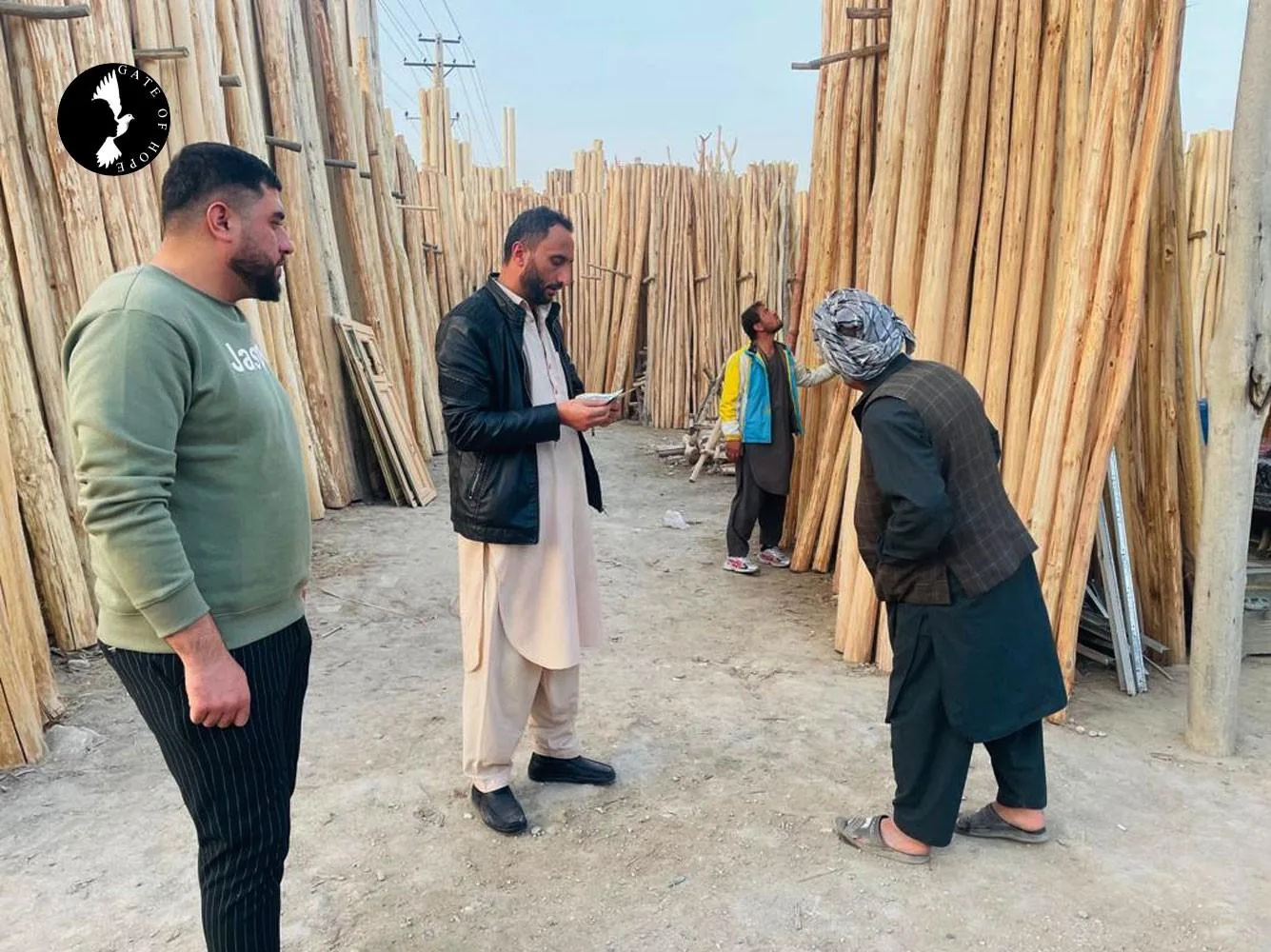
Deep inside a timber yard, a Gate of Hope representative reviewed an order surrounded by stacks of wooden poles — the unglamorous but essential work of sourcing materials that will become shelter, schools, and community spaces for Afghan families.
Groundwork for Hope: Timber Procurement and Local Sourcing
Not all community development work takes place at public ceremonies or during aid distributions. In many cases, foundational groundwork occurs quietly behind the scenes inside local commercial yards and industrial facilities. A clear example of this operational effort occurred when a Gate of Hope representative visited a regional timber yard to conduct a thorough review of a structural material order. Surrounded by tall, stacked rows of wooden poles, our representative worked directly alongside the vendor to inspect the shipment. This timber procurement phase represents an indispensable early stage in community construction projects, ensuring that lumber destined for local building sites meets safety and structural suitability standards long before assembly begins on site.
Verifying Material Standards and Structural Suitability
Material inspection requires careful attention to detail, particularly where structural timber must withstand harsh climatic conditions, heavy usage, and physical wear. During the site visit to the timber yard, our representative systematically reviewed the dimensions, straightness, and structural integrity of the wooden poles. Verifying quantities and confirming physical specifications prior to dispatch prevents costly delays at project sites and ensures that community shelters, learning spaces, and civic structures are built with dependable, high-quality materials. By maintaining strict quality verification during procurement, Gate of Hope manages donor resources responsibly while ensuring finished community buildings provide reliable protection for local families.
The Infrastructure Deficit Across Afghan Communities
To appreciate the importance of material sourcing, one must examine the severe infrastructure deficits across Afghan communities. Decades of economic instability and inadequate physical investment have left many rural and urban settlements without safe physical structures. Educational facilities face severe constraints; according to the UNESCO Afghanistan Education Situation Report 2025, nearly half of all primary schools across the country lack safe buildings, while 79 percent operate without electricity, and many remain without clean water, proper sanitation, or protective boundary walls. These structural deficiencies compromise physical safety, reduce attendance, and create serious obstacles to learning and development.
When communities lack secure buildings, children are often forced to gather in exposed outdoor spaces, and community members struggle to find safe locations for administrative gatherings or local programs. Building functional infrastructure addresses urgent needs for safety and human dignity. By sourcing durable timber materials like wooden poles, Gate of Hope supports the construction and repair of temporary learning spaces, community halls, and transitional shelters where local residents can gather safely. According to UN-Habitat's Durable Solutions Programme, restoring community infrastructure requires continuous local engagement, sound procurement practices, and sustainable material management.
Local Economic Participation and Supply Chain Integrity
A cornerstone of Gate of Hope’s operational strategy is prioritizing local material procurement whenever domestic markets permit. Rather than importing materials from abroad or relying on centralized international distributors, purchasing directly from Afghan timber yards, lumber merchants, and local tradespeople injects financial resources straight into domestic commercial networks. In an economic environment where formal employment opportunities remain limited, purchasing structural supplies locally provides direct income to merchants, supports local marketplace workers, and reinforces commercial supply chains that surrounding communities rely upon every single day.
Strengthening Local Afghan Suppliers and Market Resilience
Local supply chain partnerships extend beyond initial purchases; they help build trust and support market stability within local economies. Direct negotiation with local merchants promotes documented financial practices while ensuring project budgets are used efficiently and accountable. Furthermore, sourcing materials locally reduces transportation distance and logistical risk, enabling faster, more reliable delivery to project locations. This procurement strategy connects material purchasing directly to local economic participation, demonstrating how community development programs can support local business resilience while building necessary physical infrastructure.
Program Oversight, Rationale, and Next Steps
Constructing resilient community infrastructure is a continuous process that extends past initial procurement. Once timber orders are inspected and delivered to project sites, local builders supervise construction according to planned safety standards. Following project completion, Gate of Hope conducts routine monitoring to evaluate building performance, structural stability, and community usage across different seasons. This practical follow-up ensures that completed structures remain safe, functional, and well-maintained over the long term. However, infrastructure projects face inherent limitations, including volatile material prices and logistical constraints, which require flexible planning, realistic timelines, and honest accountability.
Delivering lasting community infrastructure requires steady, coordinated support. Donations to Gate of Hope are pooled into program funds that support every stage of project delivery. For instance, a $10 gift contributes toward pooled funds used for purchasing basic building hardware and minor supplies. A $15 donation helps support pooled funding for vocational skill development and site safety training for community workers. A $25 contribution aids in covering pooled transport and logistics costs to deliver heavy materials from supplier yards to project sites. A $50 gift supports pooled funds allocated for ongoing site monitoring, maintenance checks, and structural evaluations.
Every safe shelter, temporary school building, and community space relies on careful preparation in local supplier yards. By contributing to our pooled development funds, supporters enable Gate of Hope to maintain documented procurement, engage local Afghan vendors, and build resilient infrastructure alongside local communities. We invite you to support this ongoing work today, helping provide the essential materials needed to build safe, dignified community spaces across Afghanistan.
Ways to contribute
All gifts are pooled across the supplies, training, delivery, equipment, follow-up, and maintenance needed to run this work responsibly.
Examples describe pooled program support; they do not guarantee that a specific gift purchases a specific item or produces a fixed result.