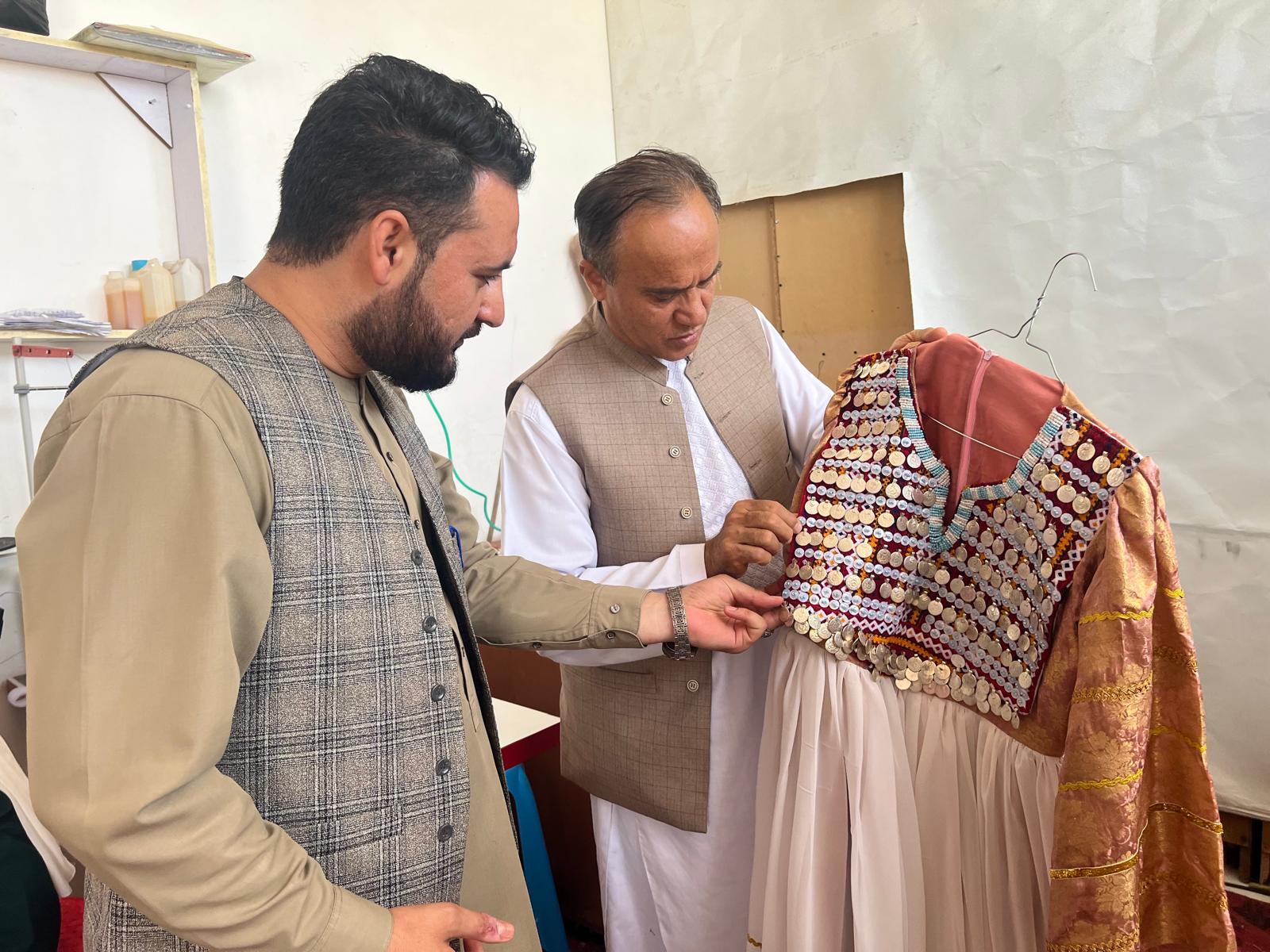
A Gate of Hope representative examined a finished leather garment as women worked at their machines behind him — a routine monitoring visit that ensures the workshops GOH supports are producing quality goods and giving women the real economic opportunity they were promised.
Quality Inspection at a Women's Tailoring Workshop
At the center of an active production space, a Gate of Hope field representative stands holding a dark leather jacket up to the light. He carefully checks the stitching along the seams, tests the weight of the material, and inspects the interior lining. In the background, two women sit focused at their sewing machines, guiding panels of fabric through steady needles. This scene captures a crucial operational moment: a practical quality inspection at a women's tailoring workshop supported by Gate of Hope.
Program monitoring in humanitarian and development contexts is often envisioned as an administrative task completed behind office desks. However, true oversight happens directly on the workshop floor where goods are crafted. For Gate of Hope, quality checks are an active, ongoing responsibility. Examining a finished leather garment side-by-side with the artisans who produced it allows field staff to assess craftsmanship, confirm material durability, and ensure that finished products meet standards necessary for local commercial sale.
The workshop represented in this monitoring visit operates as a real micro-enterprise rather than a simulated classroom. The women working at these machines produce marketable clothing items, including leather outerwear and tailored apparel. Because the financial returns of a small enterprise depend on buyer satisfaction and product reputation, maintaining production standards is essential. When garments exhibit strong construction and clean finishing, local vendors are far more likely to place recurring orders, laying a foundation for sustainable family income.
Economic Realities and the Importance of Women's Enterprise
Understanding the necessity of rigorous monitoring requires examining the broader economic context facing Afghan women today. Socio-economic assessments from international agencies highlight a severe contraction in female economic participation across the country. Data from the United Nations Development Programme indicates that female employment outside the household has stagnated at approximately 6 to 7 percent. Amid compounding economic distress, formal job opportunities for women remain extraordinarily rare, leaving countless households without adequate financial security.
In this challenging economic landscape, community-based tailoring workshops serve as a practical mechanism for livelihood support. When women gain access to sewing equipment, raw materials, and vocational instruction, they acquire tools to generate income within community-supported environments. However, simply delivering machinery and walking away is insufficient. Without ongoing technical oversight and market alignment, initial investments risk underutilization. Routine monitoring ensures that workshops retain the operational momentum needed to offer meaningful financial stability over time.
Navigating Severe Market Restrictions
Women entrepreneurs in Afghanistan navigate compounding obstacles, including restricted mobility, limited access to formal financial networks, and supply chain disruptions. In many localized economies, purchasing quality raw materials such as leather, specialized thread, and heavy-duty needles presents a persistent hurdle. Tailoring workshops provide a structured environment where women can share overhead costs and collectively fulfill larger garment orders that would be difficult to complete individually at home.
By maintaining regular visits to these production sites, field teams can identify specific operational friction points before they lead to project failure. Whether an issue involves a broken machine belt, a shortage of fasteners, or shifts in local market demand, real-time oversight allows program coordinators to adapt support strategies effectively.
Operational Oversight and Practical Logistics
Delivering effective support to community workshops demands careful operational logistics. Gate of Hope’s approach to field monitoring centers on two-way accountability. During each site visit, representatives do not merely inspect finished garments; they engage directly with machine operators to evaluate working conditions, discuss operational challenges, and assess equipment performance.
The practical logistics of running a tailoring workshop involve multiple interconnected factors. Needles wear down under heavy leather; motor belts require regular adjustment; and fabric supplies require timely replenishment to avoid production stoppages. Field representatives use routine visits to audit machine maintenance schedules, verify that inventory records match physical stock, and gather direct feedback from the women regarding their daily workflow.
Building Long-Term Enterprise Sustainability
Accountability in non-profit programming must extend beyond basic compliance. For Gate of Hope, showing up consistently demonstrates an enduring commitment to the artisans involved. When field staff review garment quality and provide constructive feedback, it reinforces a shared dedication to high production standards. Artisans gain confidence knowing that technical backup is available when machinery fails or complex patterns present production hurdles.
Furthermore, monitoring visits yield practical data regarding local market trends. Field inspectors gather information on which garment types are selling well in surrounding bazaars and which items face low demand. This empirical insight informs subsequent production planning, helping women focus their efforts on products with higher profit margins and steady market interest.
Sustaining Progress Through Shared Commitment
The documented observation of a quality check in a women's tailoring workshop reflects both immediate progress and long-term commitment. While the image records a single monitoring visit, it represents a wider operational methodology that prioritizes sustained follow-through over short-term handoffs. Transforming vocational initiatives into lasting economic opportunities requires ongoing presence, regular investment in equipment care, and continuous engagement with community workers.
To maintain and expand these monitoring and support efforts, Gate of Hope relies on pooled contributions from donors worldwide. Financial gifts are combined into flexible program funds that sustain workshop operations across multiple regions. Rather than funding isolated items, pooled resources cover the comprehensive cost structure of community programming—including sewing equipment, raw leather and textiles, fuel for transportation to remote workshops, and specialized technical guidance for artisans.
Every contribution strengthens the broader ecosystem supporting Afghan women entrepreneurs. A gift of $10 contributes toward pooled funds for basic sewing notions and maintenance items; $15 helps maintain supply chains for essential fabrics and threads; $25 supports transportation logistics for field inspectors conducting routine monitoring visits; and $50 helps fund specialized equipment servicing and advanced skill development. By contributing to these pooled resources, supporters help ensure that Gate of Hope field teams can continue showing up, inspecting work, and upholding the promise of dignified economic opportunity.
Ways to contribute
All gifts are pooled across the supplies, training, delivery, equipment, follow-up, and maintenance needed to run this work responsibly.
Examples describe pooled program support; they do not guarantee that a specific gift purchases a specific item or produces a fixed result.