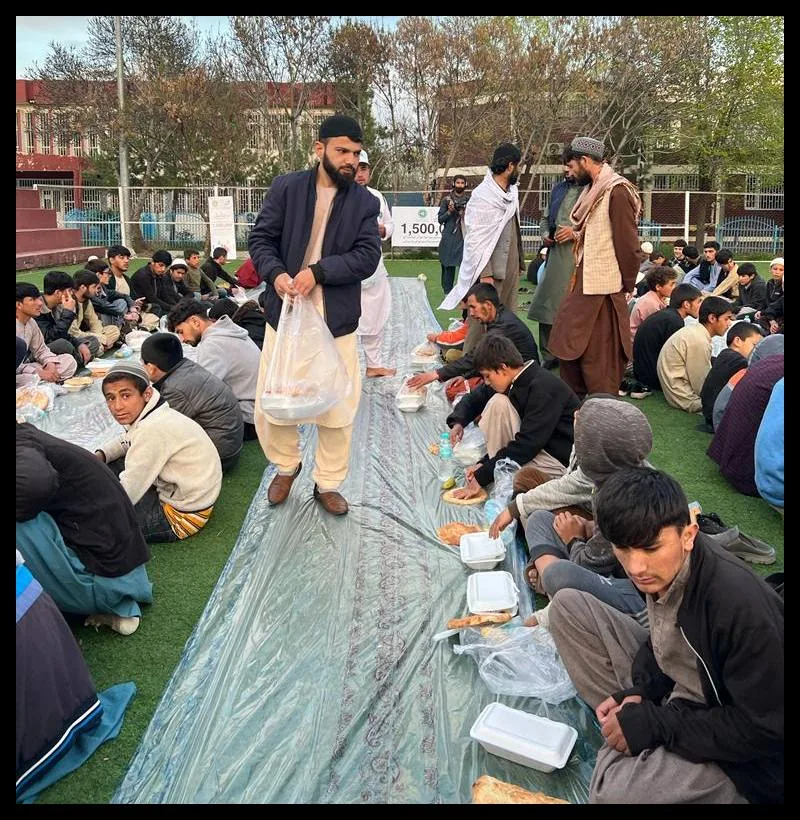
As the sun set over Kabul, 1,500 Afghans sat side by side on a sports field, food boxes and bread before them, ready to break their fast together — a Gate of Hope iftar that turned a moment of hunger into a moment of belonging.
Hosting a Ramadan Iftar for Afghan Communities
As dusk descended over an open sports field in Kabul, long rows of Afghan men and youth gathered shoulder to shoulder, seated on long ground cloths with food containers, fresh bread, and water placed systematically before them. They waited together quietly for the call to prayer signaling the end of the daily fast. This gathering represented Gate of Hope’s largest Ramadan iftar to date, bringing together 1,500 individuals in a single, coordinated act of collective care and hospitality. In a region where economic hardship often isolates families during times of observance, organizing a dignified communal meal transforms an evening fast-breaking into a powerful moment of shared solidarity and community belonging. Gathering as a unified community allows participants to share a moment of peace, reducing the social isolation that frequently accompanies acute economic distress.
Organizing an event of this magnitude requires extensive planning, sustained coordination, and dedicated community outreach. Gate of Hope’s operational staff and local volunteers worked methodically to arrange the outdoor space, ensuring that every participant was received with dignity and respect. For many attending the gathering—including displaced youth, orphans, day laborers, and heads of households without consistent earnings—the meal provided significant material and emotional relief. Sitting in an orderly, spacious setting alongside hundreds of neighbors allowed participants to break their fast with nutritious hot food while experiencing the warmth of communal support during the holy month of Ramadan. Providing a welcoming environment honors the inherent dignity of every guest.
Contextualizing Food Insecurity and Communal Need
The necessity for large-scale food distribution initiatives in Afghanistan is underscored by widespread food insecurity and economic hardship across the country. Years of protracted conflict, recurring natural disasters, and structural economic stagnation have left millions of households struggling to meet basic nutritional requirements. According to United Nations humanitarian reports, approximately 14 million people across Afghanistan experience acute food insecurity, with millions relying on external assistance to survive. During periods such as Ramadan, when food prices often rise and household reserves are stretched thin, vulnerable individuals face heightened challenges in securing sufficient daily nourishment. These severe conditions make organized community food initiatives an essential component of local humanitarian relief efforts.
The Socio-Economic Impact on Vulnerable Households
For marginalized populations, including daily wage earners whose income is unpredictable and unreliable, obtaining adequate food for evening fast-breaking presents a severe strain on meager household budgets. When families are forced to choose between purchasing basic staples or meeting other urgent survival needs, communal gatherings like iftar events provide essential material and social relief. Beyond addressing immediate nutritional gaps, providing hot meals in a structured environment helps ease the psychological burden borne by parents and breadwinners who struggle daily to feed their dependents. Creating opportunities for shared meals strengthens social bonds and offers mutual support during times of widespread hardship.
Practical Planning, Logistics, and Execution
Executing a seamless distribution meal for 1,500 people on an open field demands rigorous logistical preparation, supply chain oversight, and team coordination. Weeks prior to the event, Gate of Hope managers established procurement protocols to source fresh ingredients, contract reliable local caterers, and arrange bulk purchases of fresh bread and bottled water. Operational teams mapped out the seating grid on the sports field to manage crowd flow safely and maintain comfortable physical spacing. Volunteers were assigned specific tasks, ranging from site setup and food container assembly to table layout and orderly meal service, ensuring every container was distributed efficiently before sunset. Clear coordination prevents delays and ensures food remains fresh when served.
Accountability, Order, and Volunteer Oversight
Maintaining order and dignity during large public gatherings is essential for safe operations, participant comfort, and respectful service delivery. Field coordinators established clear entry points and verification procedures to manage attendance smoothly without causing overcrowding or confusion. Supervisory staff equipped with clipboards monitored the layout and supply counts continuously, ensuring that every seated individual received a complete meal package containing hot food, fresh bread, and clean water. This structured oversight ensured that the distribution proceeded in an orderly, tranquil atmosphere that respected the spiritual significance of the occasion for all present while safeguarding the dignity of every attendee.
Building Belonging and Mobilizing Sustained Support
While a single meal addresses immediate hunger, the broader significance of the Ramadan iftar lies in restoring a sense of human dignity and social cohesion among attendees. Being invited to a clean, well-organized public gathering where everyone is treated as an honored guest creates lasting bonds of trust between aid workers and the community. Gate of Hope recognizes that humanitarian aid must extend beyond physical sustenance to address the emotional and social isolation often caused by poverty. By creating welcoming spaces for shared meals, the organisation reinforces the social fabric of vulnerable Afghan neighborhoods, demonstrating that collective care can bring hope during difficult times.
Sustaining broad community feeding projects throughout Ramadan and beyond requires continuous support from generous donors worldwide. Financial contributions given to Gate of Hope are pooled across program areas to cover essential operational costs, including food procurement, kitchen logistics, transportation, site setup, and volunteer management. Rather than purchasing individual food parcels or guaranteeing specific participant numbers, pooled contributions ensure that resources can be allocated flexibly where need is greatest. We invite supporters to help us sustain these critical feeding programs, ensuring no one faces the fast alone and that every community member receives respectful support.
Ways to contribute
All gifts are pooled across the supplies, training, delivery, equipment, follow-up, and maintenance needed to run this work responsibly.
Examples describe pooled program support; they do not guarantee that a specific gift purchases a specific item or produces a fixed result.