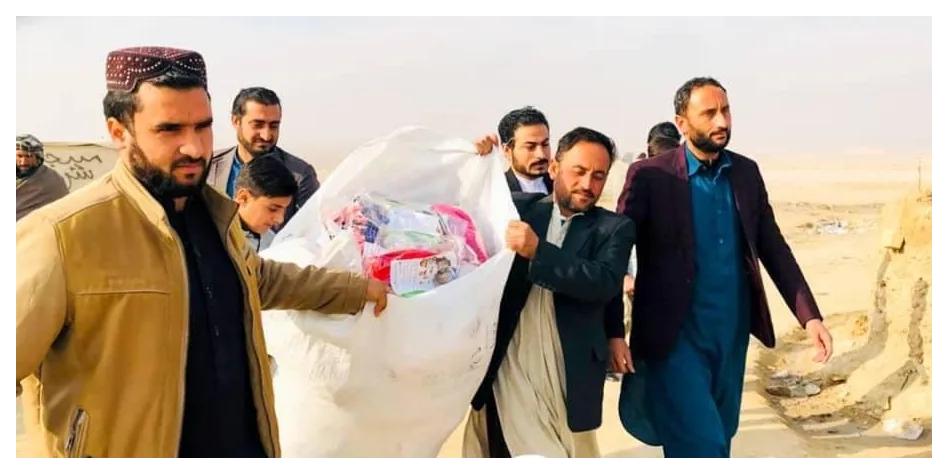
Across open desert terrain, a Gate of Hope field team carried a large bag of supplies on foot — because the families who need help most are often the ones furthest from any road, and Gate of Hope goes to them regardless.
Carrying Aid into Remote Afghan Communities on Foot
When paved roads end and vehicle access becomes impossible due to steep inclines, deep sand, or broken trails, humanitarian aid in rural Afghanistan often comes to a complete halt. However, effective remote aid delivery requires stepping beyond where conventional transport can travel. In the arid rural stretches of Afghanistan, Gate of Hope field teams carry essential supplies on foot across open desert terrain, ensuring that geographic isolation does not determine whether a family receives emergency assistance. A documented field journey captures team members moving purposefully across the dry landscape, carrying heavy bags of relief supplies toward settlements located miles from any accessible road network. These physical efforts target families residing in remote Afghan communities that formal aid distribution networks and provincial infrastructure frequently struggle to reach, bringing crucial relief directly to their doorstep.
Overcoming Infrastructure Barriers Across Arid Terrain
Navigating unpaved, severe desert terrain requires rigorous physical stamina, precise route planning, and coordinated teamwork among field staff. Operational teams assemble essential items—including food staples, hygiene supplies, and seasonal protective clothing—well before dawn to begin journeys across dusty desert expanses while temperature conditions remain manageable. Transporting supplies on foot across long distances ensures that vital materials reach households cut off by insurmountable geographic barriers. Rather than relying solely on vehicle drop-offs along primary transit corridors or urban hubs, walking directly into remote areas guarantees that assistance reaches the specific off-grid locations where vulnerable households reside, filling a critical gap in humanitarian coverage across isolated rural sectors.
The Broader Scale of Rural Need in Afghanistan
The reality facing rural populations across Afghanistan is shaped by severe infrastructure deficits, persistent economic hardship, and widespread humanitarian disruption. According to recent humanitarian reporting by United Nations agencies, an estimated 21.9 million individuals across the country require urgent humanitarian assistance, with over 11.6 million children needing continuous support. In isolated rural districts, families face complex compound challenges: severely restricted access to basic commercial markets, an absence of nearby healthcare facilities, and extreme climate pressures including prolonged droughts and severe seasonal temperature fluctuations that threaten local livelihoods and food security.
When logistical barriers and budget constraints prevent large international relief organizations or government agencies from maintaining a continuous presence in remote provinces, families living outside major municipal centers are left particularly vulnerable. Without reliable transportation services or functioning paved roads, purchasing basic household staples requires long, costly journeys that impoverished families simply cannot afford. Providing direct, targeted aid to these underserved settlements helps alleviate immediate daily strain while honoring the inherent dignity and resilience of rural communities striving to survive under harsh environmental and economic conditions.
Practical Logistics, Supply Packing, and Operational Discipline
Delivering assistance on foot to isolated communities demands detailed operational preparation long before team members step onto dusty desert paths. Every expedition begins with thorough community coordination to assess urgent necessities, audit local inventory, and securely package supplies for long-distance foot transit. Field teams carefully balance heavy distribution sacks to maximize volume while keeping loads manageable over hours of walking across uneven, rocky ground. Packing personnel systematically organize food items, basic hygiene items, and warm garments inside heavy-duty, weather-resistant sacks to safeguard the contents against pervasive dust, wind, and heat during transit.
Careful Logistics and Responsible Delivery
Maintaining meticulous delivery records and establishing direct engagement with local community elders ensures that distributions remain orderly and equitable. Gate of Hope emphasizes strict operational accountability at every stage of the supply chain, tracking inventory from initial packing warehouses to final delivery points in distant villages. By engaging directly with head of household representatives upon arrival, field personnel verify that distributed aid packages reach those most in need. This direct, hands-on methodology minimizes administrative overhead, eliminates middle-tier losses, and fosters deep operational trust with remote populations who seldom receive aid visits.
Community Follow-Up and How Pooled Support Reaches Isolated Families
The successful completion of a single physical journey across the desert represents one component of a broader, sustained effort to assist underserved Afghan communities. Following initial supply distributions, Gate of Hope field teams conduct structured follow-up monitoring whenever conditions permit to evaluate how resources are utilized and to track evolving seasonal needs. Assessing the practical outcomes of aid deliveries helps inform future distribution schedules, refine supply selections, and guide ongoing community outreach strategies. Demonstrating consistent operational discipline ensures that emergency humanitarian relief acts as a reliable, dignified bridge toward greater family stability across isolated regions.
Sustaining off-road logistics and reaching households situated far beyond vehicle access points depends entirely on dependable donor support. Financial contributions made to Gate of Hope are pooled into dedicated program funds rather than restricted to individual isolated transactions. Pooling resources provides operational teams with the vital flexibility required to procure relief goods locally, finance necessary overland transport to road-end staging areas, procure durable carrying equipment, and maintain dedicated field staff who undertake these demanding foot journeys.
Every contribution directly strengthens our collective capacity to navigate challenging terrain and deliver vital aid where need is greatest. For instance, a gift of $10 helps contribute toward pooled local procurement of essential food and hygiene items for vulnerable families. A gift of $15 helps support pooled regional transport and fuel expenses required to move supplies to remote distribution staging points. A donation of $25 contributes toward pooled protective equipment, durable packing sacks, and safety gear for field teams carrying loads across rugged desert trails. Finally, a gift of $50 helps sustain pooled funding for comprehensive follow-up community assessments and operational management in isolated districts. Together, these pooled gifts allow field teams to keep moving forward.
Ways to contribute
All gifts are pooled across the supplies, training, delivery, equipment, follow-up, and maintenance needed to run this work responsibly.
Examples describe pooled program support; they do not guarantee that a specific gift purchases a specific item or produces a fixed result.