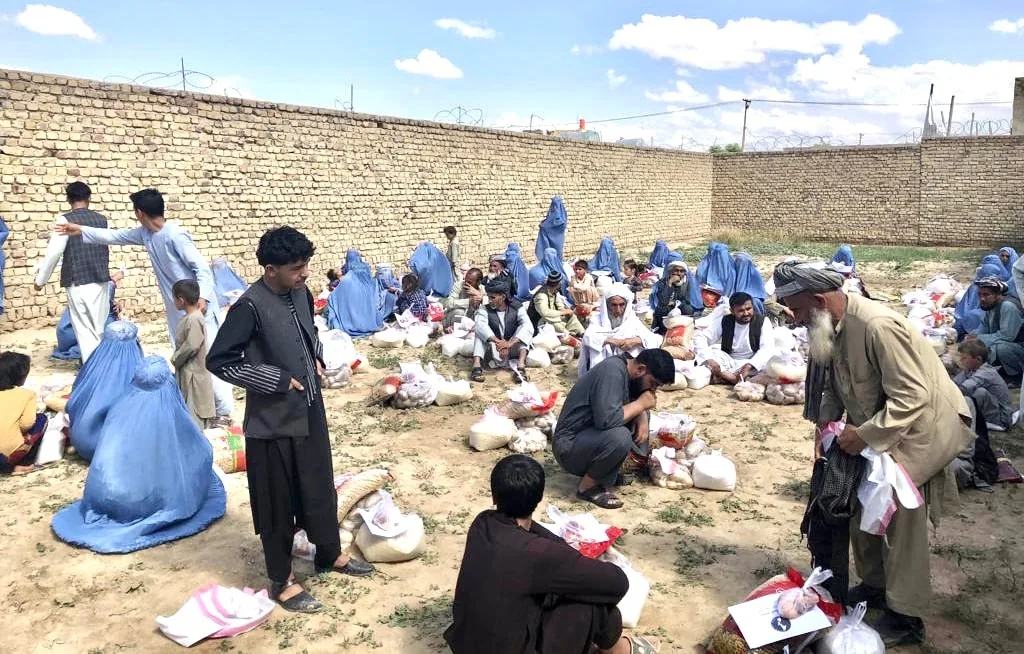
When floods devastated communities in Faryab province, Gate of Hope responded with emergency food and relief packages for displaced families — women, children, and elders gathered in an open distribution site to receive critical support.
Emergency Aid to Flood Victims in Faryab Province
In the immediate aftermath of severe flash flooding across Faryab province in northern Afghanistan, Gate of Hope mobilized its local field teams to deliver emergency aid to flood victims in Faryab province. The disaster struck rural communities with devastating force, destroying fragile mud-brick homes, sweeping away irreplaceable livestock, and severely damaging agricultural livelihoods. For hundreds of affected families, the sudden destruction of shelter was accompanied by the complete loss of household food reserves, clean drinking water access, and basic domestic belongings. In direct response to this widespread emergency, Gate of Hope organized rapid distribution operations designed to deliver critical survival packages directly to displaced households suffering from acute physical and economic loss.
Emergency operations were established inside a secure walled compound within the impacted district, creating a controlled open-air distribution center. Dozens of flood-affected residents—including displaced women, men, village elders, and young children—gathered inside the compound to receive essential survival supplies. The central objective of this targeted intervention was to mitigate immediate hunger and stabilization risks during the critical initial days following displacement. By supplying affected households with immediate food reserves, the response helped protect vulnerable family members while local teams conducted comprehensive field assessments to determine the full scope of damage and secondary emergency requirements across the province.
Field Logistics and Community-Led Distribution
The conditions at the distribution compound reflected the stark realities facing displaced communities in northern Afghanistan. Inside the walled facility, women dressed in traditional blue burqas sat patiently on the ground alongside their young children, seeking order and safety amid the trauma of lost homes. Nearby, male heads of household and respected community elders worked side by side with Gate of Hope staff members and local volunteers to manage logistics and facilitate an orderly process. Sacks of vital food staples—distinctly packaged in white and red bags containing essential items such as rice, flour, vegetable oil, and other basic provisions—were systematically placed before each receiving family.
Priority Verification for Vulnerable Households
To ensure that aid distribution was conducted with transparency, fairness, and maximum efficiency, Gate of Hope personnel and community volunteers systematically moved through the assembled crowd to verify beneficiary documentation. Local leaders played an indispensable role in helping identify the households that had sustained the most severe losses during the deluge. Response teams explicitly prioritized the most vulnerable segments of the population, focusing direct assistance on widowed mothers, families caring for infants or young children, and households whose homes had been completely flattened by floodwaters. This rigorous verification protocol ensured that finite humanitarian resources reached those with the least capacity to cope independently, preserving human dignity and fostering community trust during an intense crisis.
Regional Vulnerability and the Broader Humanitarian Context
Faryab province has long suffered from extreme climate vulnerability, experiencing recurring cycles of sudden seasonal flooding alongside protracted periods of drought and economic instability. When severe floods hit these rural areas, the impacts compound quickly beyond immediate structural damage to homes and farmlands. Floodwaters contaminate unprotected community water sources, destroy stored seed grain, kill essential farm animals, and wash away regional roadways, isolating entire communities from emergency healthcare and commercial markets. According to reports from international aid partners and United Nations agencies, over 21 million people across Afghanistan currently require urgent humanitarian assistance, with millions facing acute food insecurity caused by compounding environmental shocks and economic contraction.
The Critical Importance of Rapid Emergency Response
Delivering assistance within the first hours and days following a flood event is essential to prevent widespread severe malnutrition, waterborne disease outbreaks, and the adoption of extreme coping strategies by destitute families. Gate of Hope's established field presence and ongoing collaboration with local community councils enable field teams to bypass logistical bottlenecks and deliver direct aid rapidly when disasters strike. While providing sacks of rice, flour, and oil solves immediate hunger, these emergency distributions fulfill a vital broader rationale: stabilizing displaced households, preserving family cohesion, and establishing an essential safety net that enables long-term recovery planning.
Sustained Operational Commitments and How to Support
The aid distribution executed in Faryab province represents one milestone in Gate of Hope's continuous commitment to stand alongside vulnerable Afghan communities during severe disasters. While immediate food distribution addresses immediate survival needs, field teams remain active in affected districts to monitor ongoing challenges and conduct detailed needs assessments. Future assistance plans focus on evaluating shelter repair needs, distributing winterization support, and providing transitional aid for households facing prolonged displacement. Maintaining constant operational readiness ensures that local teams can deploy without delay whenever seasonal flooding or severe weather threatens northern communities.
Delivering timely, dignified disaster response requires consistent and flexible financial resources. Gate of Hope relies on contributions to its dedicated emergency relief fund from individuals, community groups, and international partners. All financial donations made to emergency programs are pooled across relevant operational categories—including the bulk purchase of food staples, emergency shelter materials, regional transport and fuel costs, beneficiary verification logistics, and post-distribution monitoring assessments. By contributing to pooled humanitarian funds, supporters enable field teams to respond instantly with targeted supplies, practical care, and essential relief whenever sudden disaster strikes vulnerable Afghan families.
Ways to contribute
All gifts are pooled across the supplies, training, delivery, equipment, follow-up, and maintenance needed to run this work responsibly.
Examples describe pooled program support; they do not guarantee that a specific gift purchases a specific item or produces a fixed result.