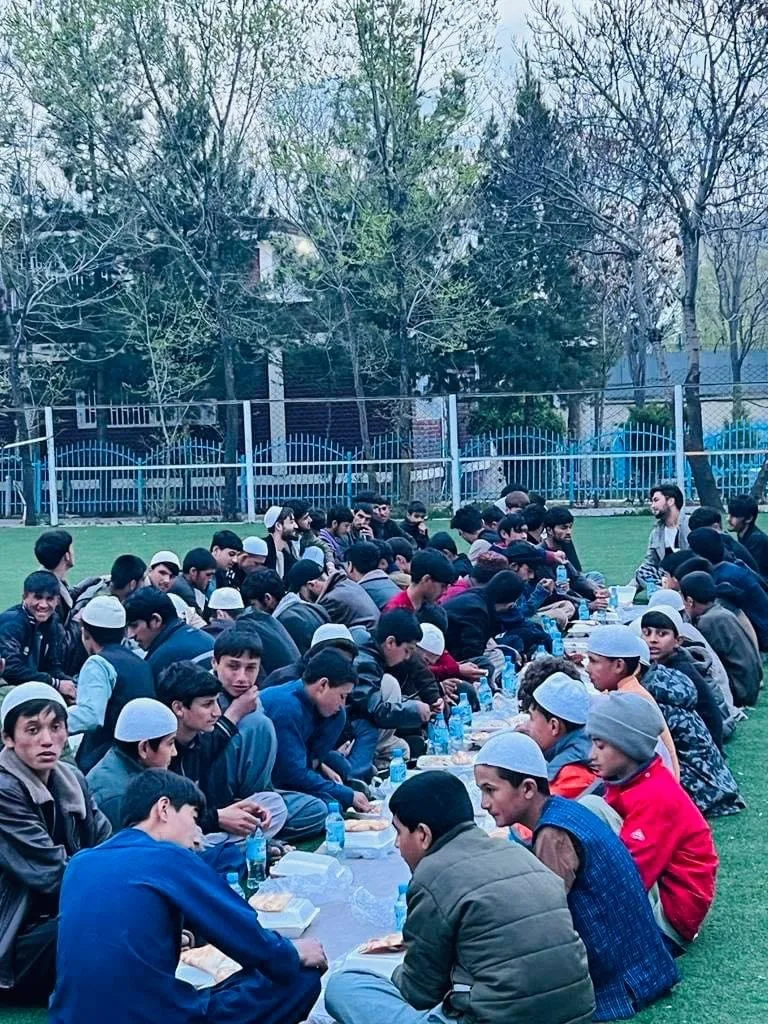
Under a cold mountain sky, hundreds of Afghan boys gathered on a green sports field to break their Ramadan fast together — a single long table stretching across the turf, set with water, bread, and dates. This is what solidarity looks like in Afghanistan.
Gathering at the Table: Community Iftar in Mountain Afghanistan
Under a cold mountain sky, long communal tables stretched across a green sports field, creating a remarkable sight in a remote district of Afghanistan. Ringed by hundreds of young boys wrapped in winter caps and heavy jackets, the gathering marked a moment of quiet solidarity as the evening call to prayer echoed off the surrounding hills. Set with fresh bread, clean water, and dates, the single extended table served as a central venue for a Gate of Hope community Iftar. This event brought together orphaned children, street youth, displaced boys, and young members of impoverished households to break their Ramadan fast side by side in a dignified setting.
Organized directly on the open turf, the initiative was designed around simple accessibility and deep respect for every guest. Volunteers moved continuously along the rows of seated children, placing trays of fast-breaking staples, serving hot tea or water, and ensuring that no child was overlooked. There were no admission tickets, required identification documents, or means-tests enforced at the entrance of the field. The invitation extended to every child walking onto the field was clear and open: join the gathering, break the fast, and share a warm space among peers. For many attendees, who had walked long distances from neighboring informal settlements and low-income quarters under harsh winter weather, the evening provided crucial nourishment and a profound sense of communal belonging in the face of persistent hardship.
Food Insecurity and the Reality for Afghan Youth
The necessity of large-scale community fast-breaking events stems from severe socio-economic conditions affecting households throughout the country. According to official humanitarian assessments, an estimated 21.9 million individuals in Afghanistan require urgent humanitarian assistance, including more than 11.6 million children. Furthermore, reports from international aid agencies indicate that approximately 14 million people face acute hunger, with widespread food deficits impacting vulnerable young populations in mountainous and isolated regions where extreme winter cold amplifies daily deprivation and nutritional vulnerability.
The Daily Struggle in Informal Settlements
Many of the boys attending the sports field gathering came from households operating without stable livelihoods or adult breadwinners. In these informal settlements, families struggle continuously to secure basic nutritional needs, warm clothing, and heating fuel during severe winter months. Data from the United Nations Development Programme notes that widespread economic stagnation continues to strain household budgets, leading to increased rates of early informal labor among young boys attempting to contribute to family survival. When seasonal fasts occur under such demanding economic pressures, providing an organized meal removes an immediate financial burden from struggling caregivers and ensures growing youth receive vital nutrients at the end of a long fasting day.
Field Operations and Respectful Food Delivery
Executing outdoor community gatherings of this scale requires careful local coordination, efficient transport, and robust field logistics. Organizing a community Iftar in mountain terrain involves procuring thousands of flatbreads, fresh dates, and clean drinking water, alongside preparing or transporting hot food items in thermal containers. Gate of Hope field teams coordinate with local community elders, food vendors, and neighborhood volunteers weeks in advance to ensure that all items are sourced safely and prepared under strict hygienic standards near the distribution site.
Operational Accountability and Volunteer Stewardship
Practical delivery hinges on dedicated local staff and neighborhood volunteers who manage line setups, food safety, seating arrangements, and respectful crowd management. Long tables and protective ground coverings are laid out hours before sunset so that every participant finds a clean, welcoming place waiting for them upon arrival. Volunteers receive clear guidance on maintaining dignified interactions, prioritizing the youngest and most vulnerable attendees, and ensuring that latecomers are promptly served. Operational tracking allows Gate of Hope to monitor distribution counts accurately, manage supply lines effectively, and document project activities to maintain transparency for international donors and community partners.
Sustaining Ramadan Programs and Broader Community Support
While a single community meal offers essential immediate relief, seasonal Ramadan programming also serves a strategic role in Gate of Hope’s broader humanitarian mission. Gathering youth in structured, safe environments provides field staff with valuable opportunities to observe community needs, identify severe child malnutrition cases, and evaluate local protection concerns. By establishing trust through transparent, community-grounded service, aid teams build the relationships necessary to plan subsequent educational, nutritional, and winterization interventions across underserved mountain districts.
Sustaining these large-scale gatherings requires ongoing financial backing from compassionate individuals across the globe. All contributions made to Gate of Hope are pooled into dedicated program funds that support a wide range of operational necessities, rather than purchasing single items or guaranteeing individual outcomes. Donors can contribute through structured tiers to strengthen overall service capability across rural and urban centers:
- $10 helps support pooled resource funds used to procure basic food ingredients, dates, and clean water distribution supplies for seasonal meal gatherings.
- $15 contributes to shared operational budgets that cover bulk transport, field logistics, and food prep equipment for community outreach events.
- $25 supports pooled community programs, facilitating staff coordination, volunteer logistics, and child safety management across outdoor sites.
- $50 aids overarching humanitarian operations, assisting with post-event site cleanup, supply maintenance, and continuous community need monitoring.
As economic pressures continue to challenge families across Afghanistan, expanding seasonal food outreach remains an urgent priority. By standing in solidarity with vulnerable children, international supporters help ensure that no child must face hunger alone during holy observances.
Ways to contribute
All gifts are pooled across the supplies, training, delivery, equipment, follow-up, and maintenance needed to run this work responsibly.
Examples describe pooled program support; they do not guarantee that a specific gift purchases a specific item or produces a fixed result.