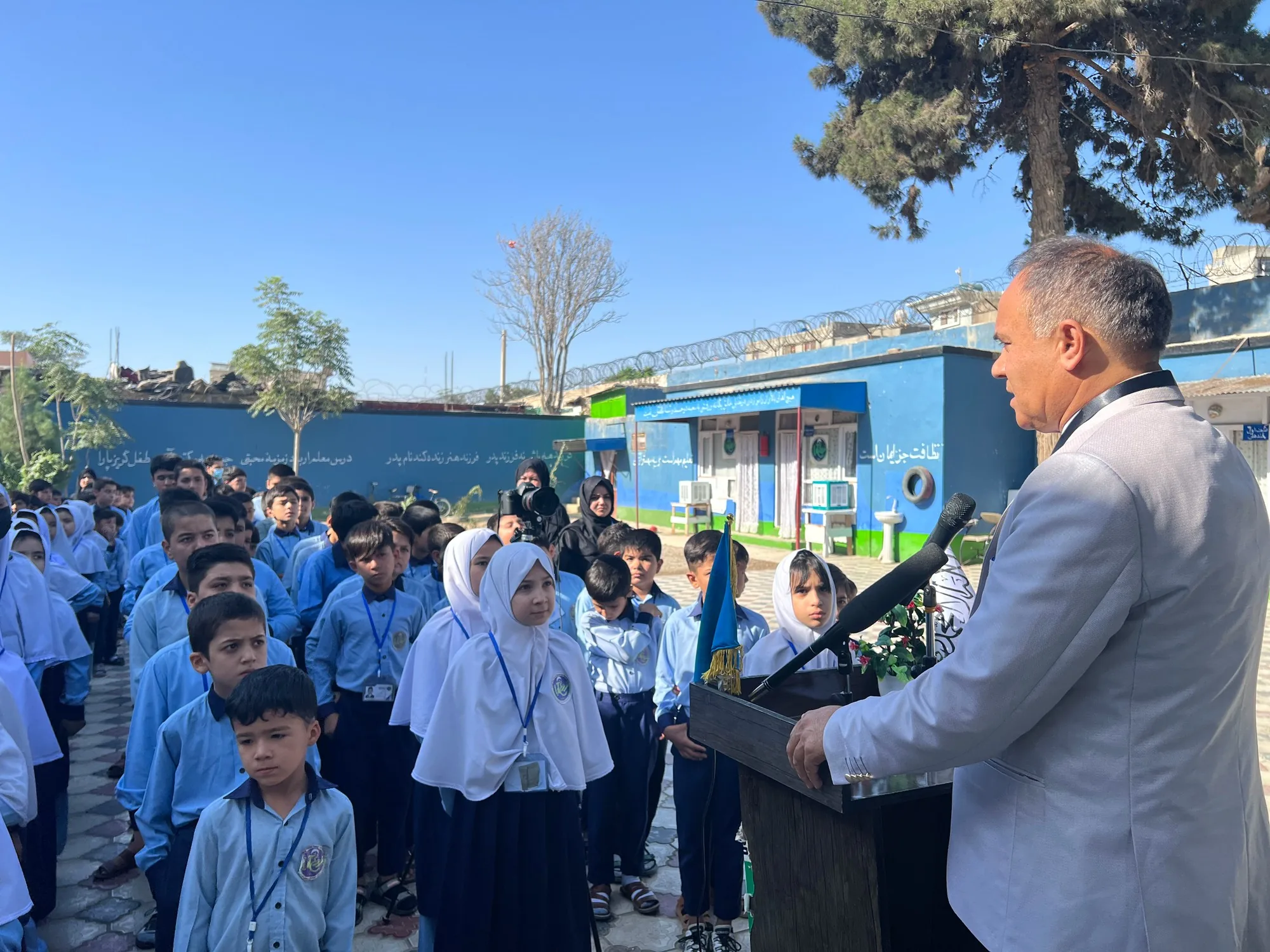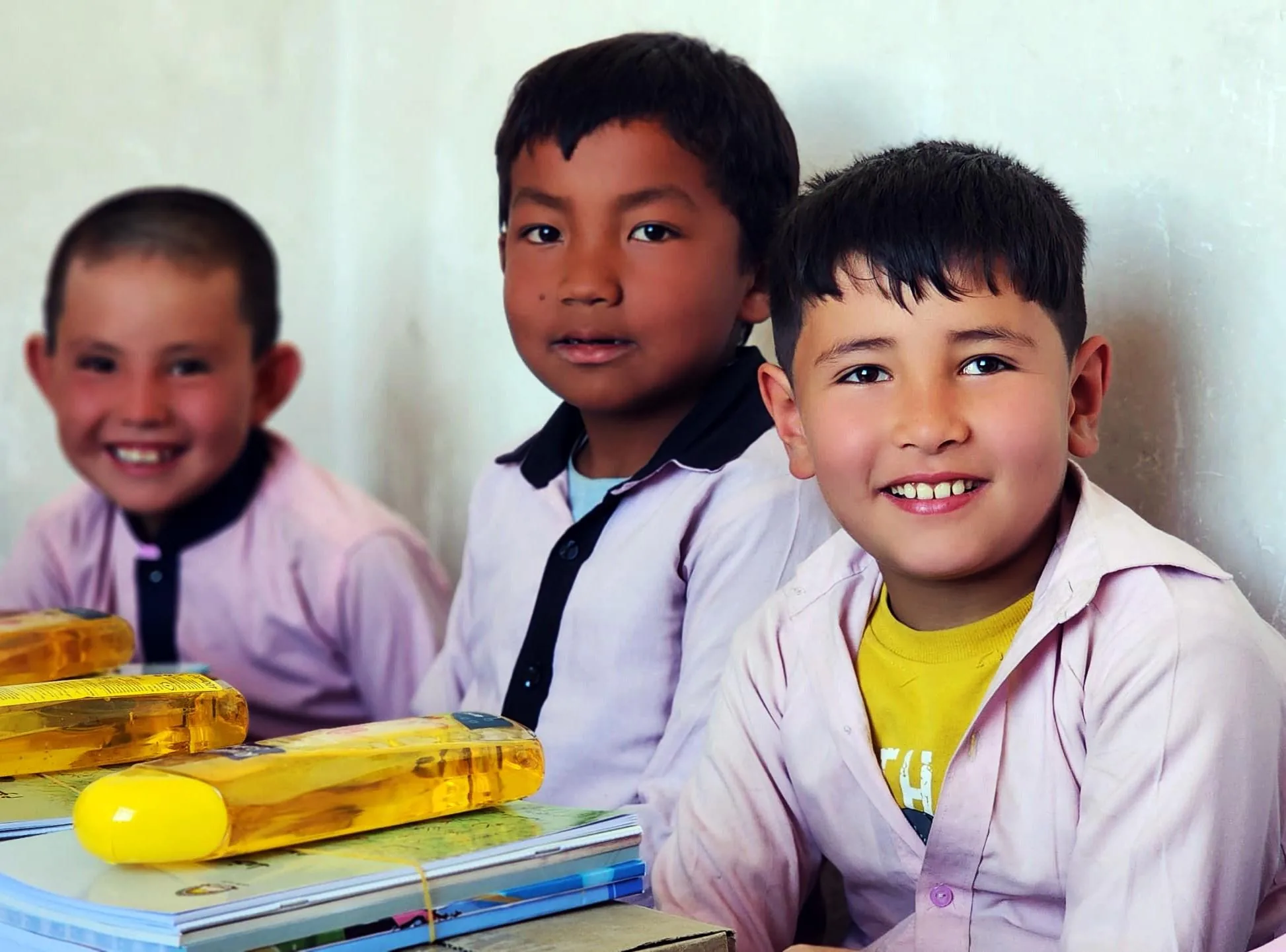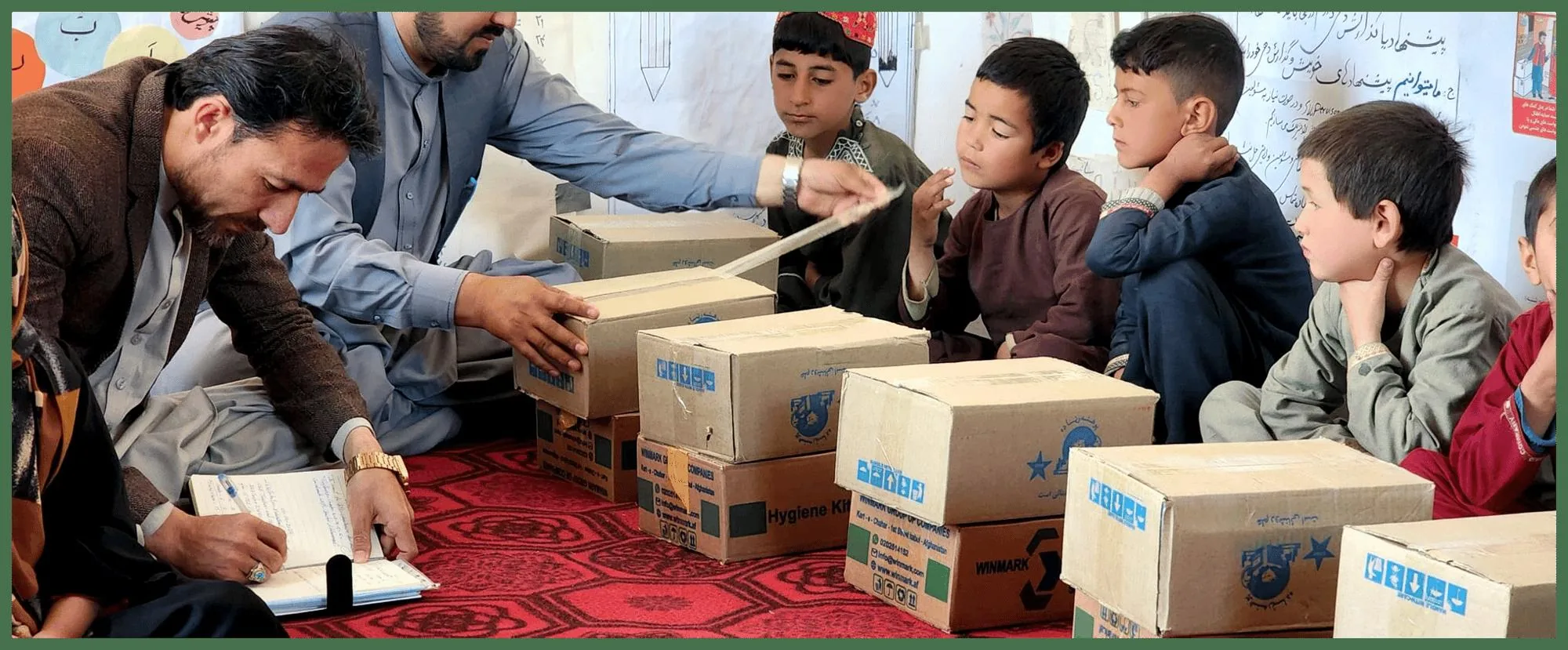
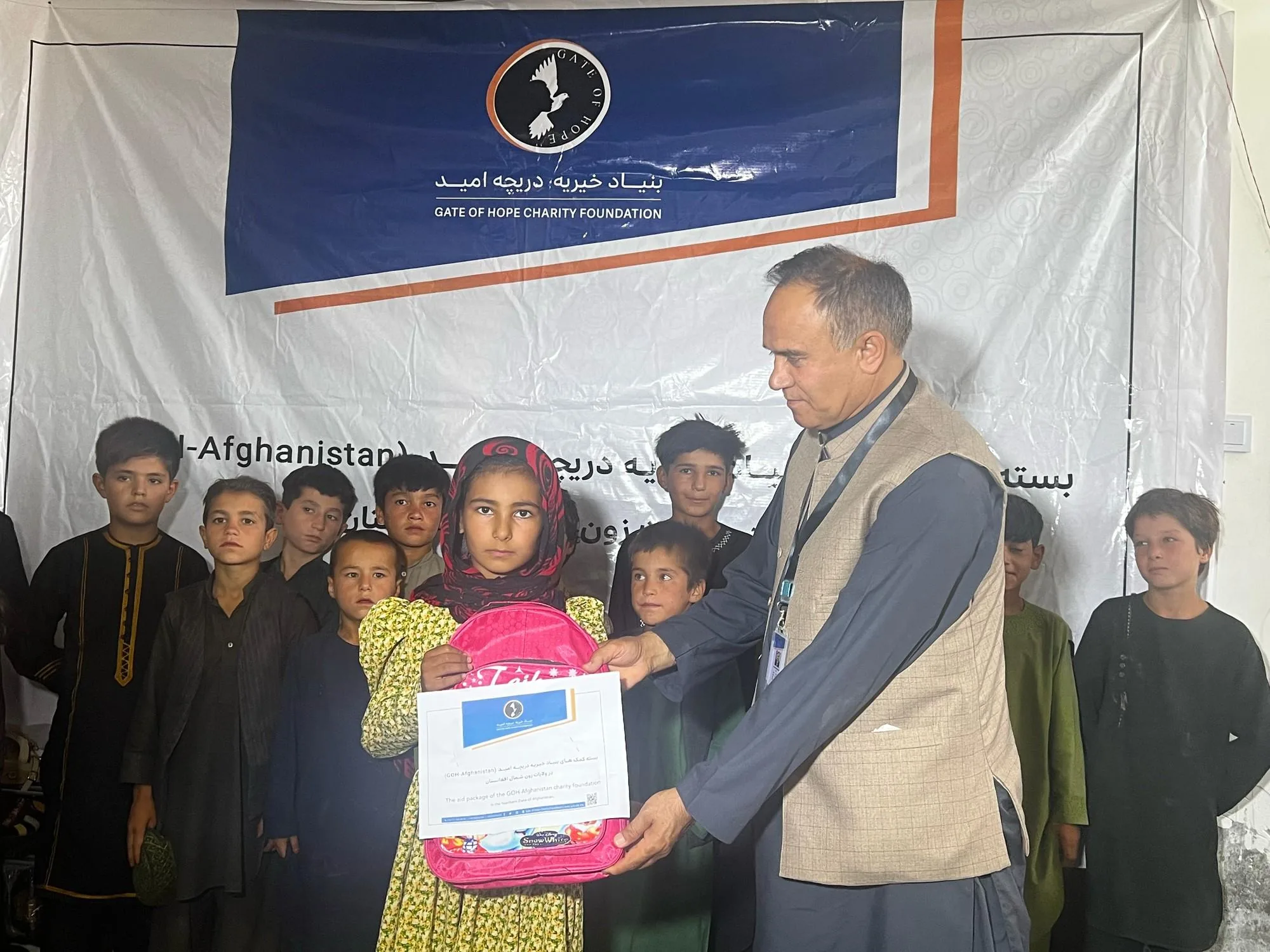
Under the Gate of Hope banner, a young Afghan girl received her school backpack and certificate directly from a senior GOH representative — surrounded by children who watched and waited for theirs.
Direct Handover: School Backpack Distribution in Action
At a formal distribution ceremony, a young Afghan girl stepped forward toward a senior Gate of Hope representative. Dressed in her community clothes, she extended her hands to receive a bright pink school backpack packed with essential stationery and learning supplies. Alongside the bag, she was presented with an official certificate bearing the Gate of Hope seal. Positioned behind the official banner, a group of local Afghan children looked on attentive and patient, observing the handover while waiting for their turn to step forward and receive their own essential school gear.
This organized gathering was designed to uphold the dignity of every student in attendance. Rather than distributing items informally, the event structured the transition into learning as a meaningful ceremony. Each backpack delivered into a child’s hands contained concrete tools—pencils, notebooks, and foundational writing implements—that reduce immediate household burdens. For children who had previously lacked even basic writing paper, standing before their peers and receiving dedicated materials marks a clear operational step toward active educational participation.
Beyond the immediate physical items, the distribution served as a practical focal point for the surrounding community. Parents, elders, and nearby residents observed as young boys and girls were acknowledged individually. In resource-constrained environments where educational materials are scarce or prohibitively expensive, witnessing every child systematically receive identical, quality supplies reinforces equal preparation across the group. The quiet order of the distribution reflected a structured effort to ensure that equipment reaches every registered recipient directly.
Educational Context Across Afghanistan
Ensuring that children are equipped before entering the classroom supports broader educational efforts throughout the region. While material provision alone cannot resolve wide systemic deficiencies like missing infrastructure or teacher shortages, ensuring every child carries their own learning kit establishes a functional baseline. Students who possess their own notebooks and writing instruments can engage in classroom activities immediately, take notes, and complete home exercises, thereby maximizing the instructional value of available learning spaces.
Systemic Barriers to Primary Education
The distribution of basic school supplies takes place against a backdrop of severe national educational challenges. According to data from international reporting, including UNESCO's Afghanistan Education Situation Report 2025, over 2.13 million primary school-aged children across the country are currently out of school, with girls representing roughly 60 percent of this unserved population. Furthermore, national educational infrastructure suffers from severe structural deficits: nearly half of all existing primary schools lack safe, permanent buildings, approximately 79 percent operate without electrical power, and many facilities operate without functional water, sanitation, or protective perimeter walls.
In communities burdened by severe economic pressure, the cost of basic school supplies—including simple items like backpacks, notebooks, pens, and paper—often presents a decisive barrier to a child's attendance. When families are forced to choose between daily survival needs and purchasing educational materials, children frequently remain home or fall behind in basic literacy and numeracy skills. Providing children with complete, pre-packed learning kits addresses this material gap directly at the household level, removing an immediate financial obstacle to school readiness.
Dignity, Documentation, and Practical Preparation
The physical design and assembly of the learning packs prioritize practical utility and durability. The bright pink backpacks featured in the distribution are chosen to withstand daily wear on long walking routes to school, protecting vulnerable paper materials from environmental dust and moisture. Inside, stationery items are systematically arranged to ensure children receive complete writing sets ready for immediate classroom use, eliminating the need for partial borrowing or shared equipment among students.
Formal Recognition and Family Trust
The inclusion of an official certificate accompanying each school backpack serves a deliberate, practical purpose beyond the physical supplies. Printed with the recipient's name, the date of the distribution event, and the official Gate of Hope seal, this document provides families with a formal, tangible record of recognition. In areas where children's individual progress is easily lost amidst broader hardship, receiving a personalized document validates the student's status as an active learner whose education is valued and formally recorded.
Formal documentation helps foster trust between local families and humanitarian program teams. By issuing an official certificate, Gate of Hope creates an accountable record of interaction with each participating family. This paper record serves as a lasting reminder within the household that the community and partner organizations recognize the child's right to learn. For parents, holding a formal certificate offers a sense of validation, reinforcing their decision to prioritize their children's ongoing participation in available educational programs.
Pooled Resources and Sustainable Follow-Up
Sustaining educational distributions across remote and underserved Afghan communities relies on effective logistics, community cooperation, and careful resource management. Gate of Hope operates by pooling donor contributions to fund entire operational cycles—from purchasing bulk educational materials and assembling complete student kits to arranging secure local transport and conducting orderly distribution events. This pooled approach allows operational teams to adapt to shifting local conditions and allocate resources dynamically to where community needs are most acute.
Post-distribution monitoring and community engagement form an essential component of Gate of Hope's educational initiatives. Local representatives return to participating communities to observe whether children are actively utilizing their supplies in learning environments and to consult with parents and local educators regarding ongoing needs. These follow-up activities provide valuable field insights that inform future distributions, ensuring that logistical workflows remain efficient, responsive, and grounded in the practical realities of Afghan classrooms.
Equipping vulnerable children with basic educational tools remains an urgent humanitarian priority in Afghanistan. Every child who receives a backpack and stationery gains a functional opportunity to participate in basic learning. Gate of Hope invites international supporters to join this ongoing effort. By contributing to pooled education funds, donors assist in covering the essential costs of supplies, transport, event coordination, and follow-up monitoring necessary to reach more children with practical learning tools.
Ways to contribute
All gifts are pooled across the supplies, training, delivery, equipment, follow-up, and maintenance needed to run this work responsibly.
Examples describe pooled program support; they do not guarantee that a specific gift purchases a specific item or produces a fixed result.