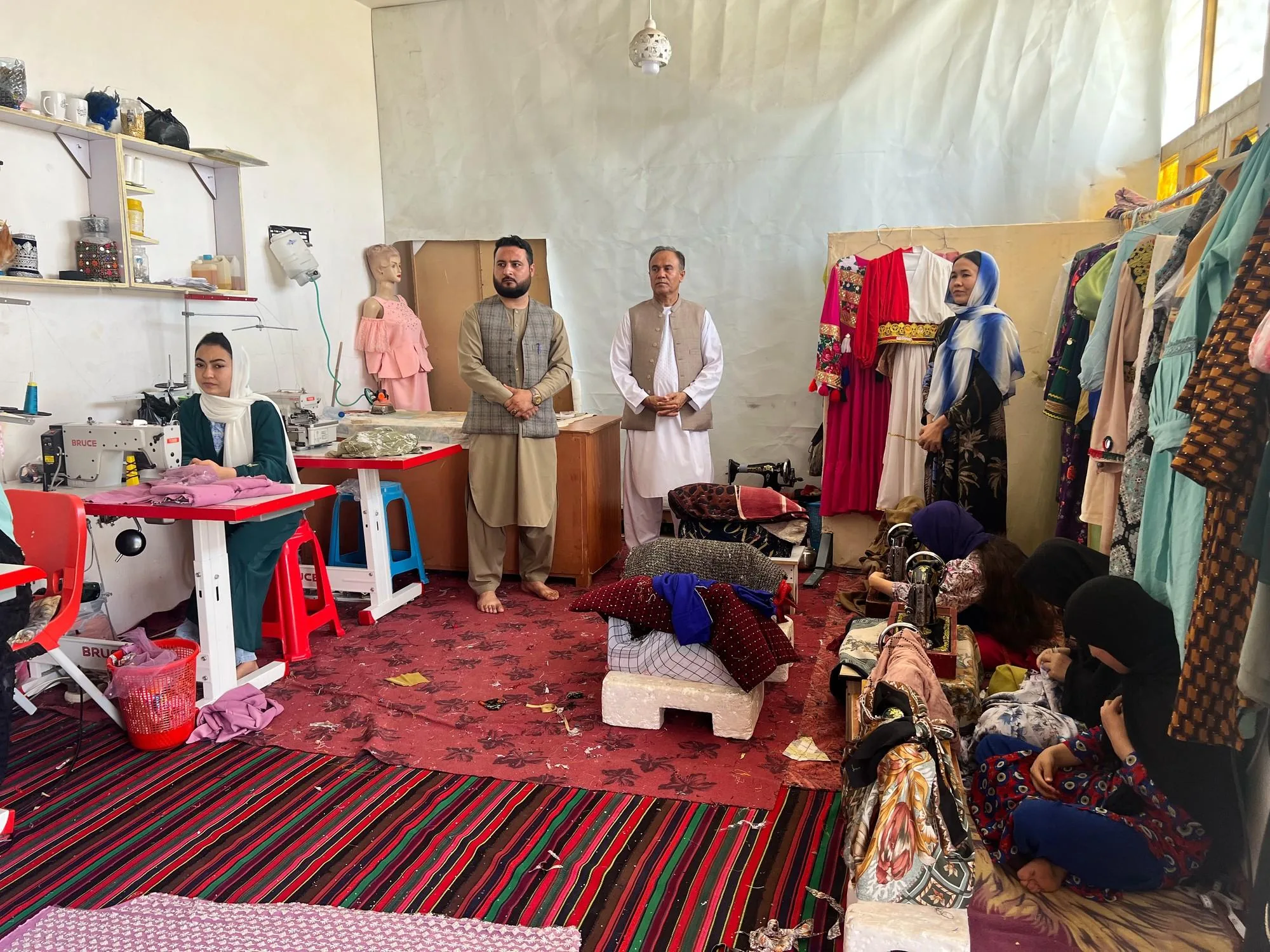
Two Gate of Hope representatives stepped into a busy home workshop — women at their machines, colourful garments hanging on the rail, a mannequin dressed in finished work — seeing first-hand how Afghan women are turning their homes into centres of production and income.
Inside a Home-Based Women's Tailoring Workshop in Afghanistan
Two Gate of Hope representatives recently conducted a site visit to a home-based women's tailoring workshop, observing how residential spaces can be adapted into active centers of skilled craftsmanship and economic activity. Inside the workshop room, women worked at their sewing machines, surrounded by the practical elements of ongoing garment production. Fabric was cut and pinned across the floor, while finished dresses and blouses hung along a display rail. A mannequin dressed in a completed pink outfit stood in the middle of the room, demonstrating the finished output and commercial potential of the items created within the space.
For many households across Afghanistan, formal commercial facilities and central industrial locations are not accessible, making informal home-based spaces essential venues for economic self-sufficiency. Rather than operating out of formal storefronts, these small tailoring operations function from living rooms and spare residential areas. The environment observed by the representatives reflected purposeful focus, with raw materials being transformed into garments through practical skill. Seeing finished clothing displayed on the rail provided clear evidence of market-ready production, showing that the workshop is actively producing items suitable for sale and turning domestic quarters into practical income-generating spaces.
The atmosphere within the home workshop highlighted the dignity and determination of women who cultivate technical skills under challenging circumstances. By utilizing domestic spaces, tailors establish structured work environments that accommodate their daily routines while maintaining high standards of production. The presence of specialized equipment and organised workspaces demonstrates how home settings can support viable micro-enterprises. These operations serve as quiet engines of household economic stability, offering practical avenues for women to contribute directly to their families' financial well-being through skilled labor.
Economic Context and Livelihood Barriers for Afghan Women
Understanding the importance of home-based tailoring requires examining the broader socioeconomic conditions facing women in Afghanistan. International reporting from organizations such as the United Nations Development Programme (UNDP) and UN Women indicates that female participation in the formal workforce remains severely limited, with significant structural barriers restricting access to traditional employment. Widespread poverty, economic instability, and high unemployment rates have created an urgent need for flexible livelihood opportunities that operate within existing social and structural frameworks. Domestic production offers a vital pathway for women to generate household income without relying on formal commercial infrastructure.
Overcoming Mobility and Caregiver Constraints
For many Afghan women, restrictions on mobility and domestic caregiving responsibilities create major obstacles to pursuing work outside the home. Caring for young children and managing domestic duties often prevent women from traveling to external production centers or commercial markets. A home workshop addresses these operational challenges by bringing tools, raw materials, and skills directly into the residential space. This structure allows tailors to manage their time effectively, balancing family responsibilities with productive work on their own terms.
By eliminating the need for daily travel to external facilities, home-based production preserves access to income generation for women who would otherwise be excluded from economic activity. The ability to work safely inside domestic spaces fosters financial autonomy while respecting personal and community circumstances. This operational model demonstrates how decentralized livelihood initiatives can adapt to complex social realities, ensuring that women retain practical opportunities to earn income and support their households.
Practical Delivery, Equipment, and Market Integration
Gate of Hope's economic empowerment strategy centers on delivering practical resources that enable women to establish and maintain functional tailoring businesses. This approach includes providing essential equipment such as sewing machines, supplying fabric and basic tailoring materials, and facilitating skills development programs. Equipping home artisans with reliable tools allows them to perform precise cutting, pinning, and stitching, as observed during the monitoring visit. These tangible resources establish the foundation required for sustainable small-scale textile manufacturing within home environments.
Building Supply Chains and Local Market Connections
Sustaining a home workshop requires more than equipment and initial training; it depends on establishing reliable connections to local commercial networks. Gate of Hope works to assist home producers by connecting their output with surrounding markets, ensuring that completed garments—such as the dresses and blouses displayed on the rail—can be sold to generate regular income. Linking home production to local commercial demand transforms basic tailoring skills into organized micro-enterprise activity, helping women build sustainable livelihoods.
Connecting home-based artisans with market opportunities helps bridge the gap between production and sales. When tailors have consistent access to raw materials and established sales channels, their workshops transition from isolated activities into integrated economic operations. This practical integration strengthens local commercial ecosystems while providing women with predictable returns on their labor, reinforcing the long-term viability of home-based garment production.
Accountability, Field Monitoring, and Community Commitment
Regular field monitoring visits by Gate of Hope representatives are essential for assessing program quality, and supporting long-term effectiveness. Direct site visits allow representatives to evaluate workshop functionality, observe equipment condition, and review product quality firsthand. Seeing finished garments, including the complete pink outfit on the mannequin, provides tangible verification of active production and practical skill application. These direct observations help identify ongoing operational needs, such as material replenishment or technical maintenance, ensuring that support remains responsive and practical.
Maintaining and expanding home tailoring initiatives requires consistent, pooled financial resources. Contributions to Gate of Hope are combined across program areas to purchase sewing machinery, procure raw fabric and tailoring supplies, support skills training modules, cover equipment transportation, and fund field monitoring activities. Individual donations do not fund specific individual businesses or guarantee specific financial outcomes; rather, they sustain a broader structural program designed to foster independent, dignified livelihoods. Supporting women as they build home-based enterprises fosters sustainable economic resilience for families and communities across Afghanistan.
Ways to contribute
All gifts are pooled across the supplies, training, delivery, equipment, follow-up, and maintenance needed to run this work responsibly.
Examples describe pooled program support; they do not guarantee that a specific gift purchases a specific item or produces a fixed result.