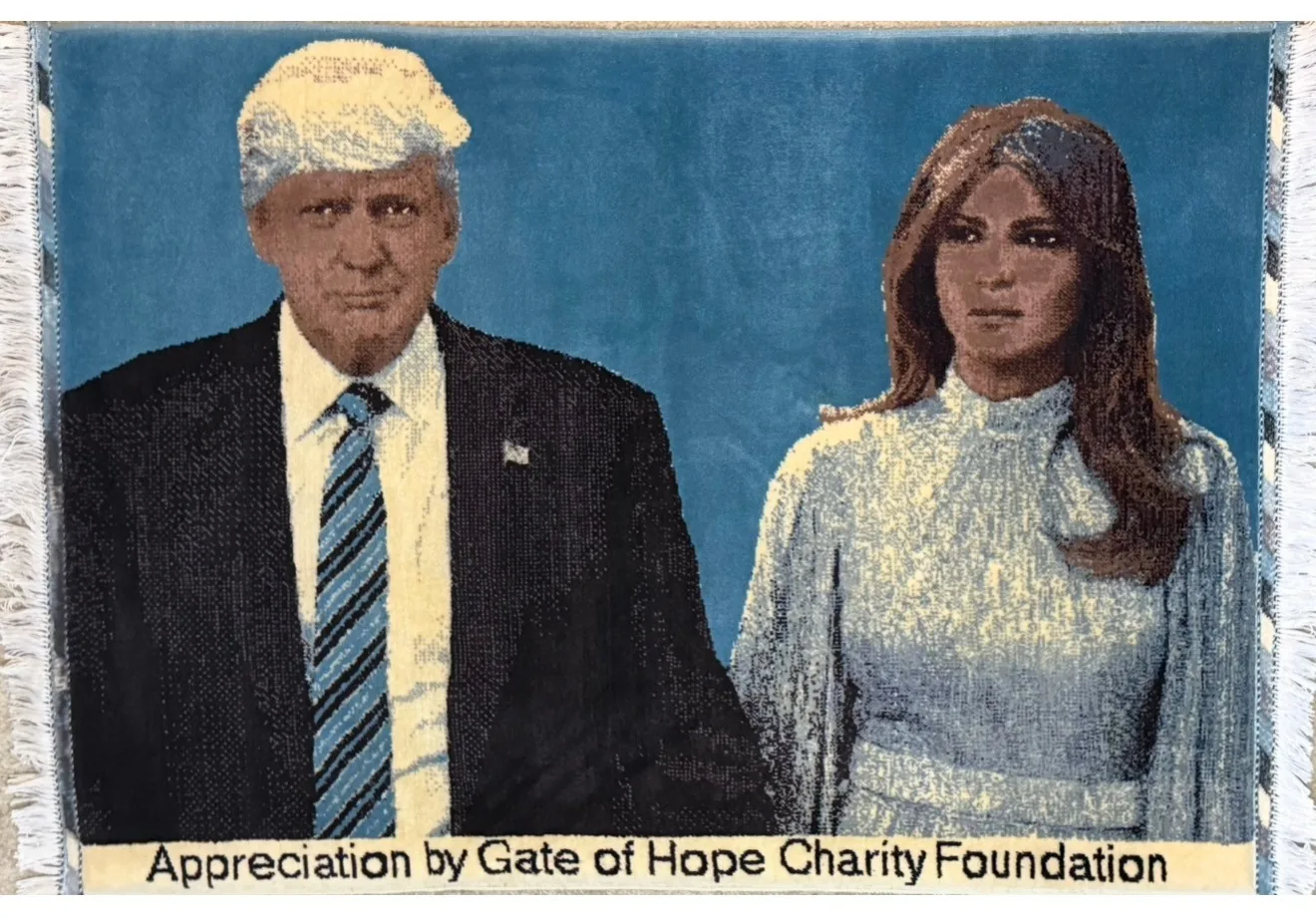
Women carpet weavers in Afghanistan wove a hand-knotted carpet as a gift to First Lady Melania Trump — a message of hope, resilience, and gratitude from the women of Afghanistan, presented by Gate of Hope.
Afghan Women Carpet Weavers and the Presentation of a Handwoven Gift
Afghan women carpet weavers in Afghanistan recently crafted a hand-knotted carpet as a ceremonial gift to First Lady Melania Trump of the United States, an act presented on their behalf by Gate of Hope. The specialized piece features a portrait depiction of the former President and First Lady together, finished at the bottom with a clear inscription reading "Appreciation by Gate of Hope." For the women artisans who tied each knot, this creation was far more than an ordinary artistic effort or official gift. It was a dignified statement of endurance, technical mastery, and recognition sent directly from rural workshops to the global stage.
Cultural diplomacy through artisan craft offers a quiet yet powerful channel for self-expression. By choosing to weave this specific portrait, the weavers demonstrated how traditional artistic skills can bridge vast geographical and cultural divides. Every row of knotting represents hours of painstaking concentration, turning raw wool and dye into a detailed portrait that conveys gratitude for international attention while reaffirming the enduring agency of Afghan women. Through this presentation, Gate of Hope sought to ensure that the dedication, talent, and humanity of these weavers were shared directly with leadership and audiences abroad.
Preserving Cultural Heritage in the Face of Economic and Social Challenges
Afghan carpet weaving stands as one of the country's most ancient, revered, and intricate traditional crafts. Historically carried out by women working inside rural households and small community workshops, the art form demands immense discipline and patience. Individual carpets are knotted meticulously by hand over many months of concentrated labor. Within every design choice, color palette, and geometric pattern lies a quiet narrative reflecting local identity, ancestral memory, and individual creativity. When these women sat at their looms to weave this presentation piece, they were asserting their active role in preserving an irreplaceable living history.
Understanding the Economic Reality for Women Artisans
The broader context facing women across Afghanistan highlights the heightened significance of preserving traditional livelihoods. Contemporary international documentation, including reports from UN Women and the United Nations Development Programme (UNDP), indicates that Afghan women confront severe, systemic restrictions across education, formal employment, and public movement. Recent statistical assessments show female employment outside the household hovering at approximately 7 percent, reflecting near-total social and economic marginalization for millions of women across the country.
In an environment where formal jobs and secondary schooling remain strictly curtailed, household-based and workshop-based artisan production represents one of the few remaining avenues for women to utilize their skills. Engaging in carpet weaving allows women to generate vital income for their families while maintaining personal dignity within their communities. Initiatives that support female artisans help prevent complete economic disenfranchisement, transforming home-based craftsmanship into a vital pillar of family survival and community resilience during a time of widespread economic stagnation and humanitarian hardship.
Gate of Hope's Programmatic Framework and Operational Logistics
Gate of Hope operates women's empowerment initiatives designed to support carpet weavers, tailors, artisans, and small-scale entrepreneurs across multiple provinces in Afghanistan. Recognizing that skill alone cannot overcome systemic economic isolation, the organization works to build practical pathways that connect local producers with essential resources and broader markets. By assisting women in securing high-quality materials, refining technical practices, and establishing reliable distribution avenues, the program aims to convert traditional household knowledge into sustainable economic opportunity and long-term financial security.
Practical Delivery, Monitoring, and Sustainable Markets
Implementing non-formal livelihood programs in complex environments requires careful operational planning and continuous coordination. Program activities center on procuring durable looms, quality wool, and natural dyes, followed by transporting these essential supplies to community workshops and home spaces where women can work safely. Facilitators coordinate localized training sessions to refine weaving precision, business basics, and design consistency. Maintaining consistent follow-up and field monitoring ensures that materials are utilized effectively, production standards are met, and participants receive equitable support for their labor.
Bridging the gap between isolated rural workshops and external markets remains an ongoing logistical challenge. Gate of Hope works to establish practical transport routes and organizational networks capable of moving finished products safely from remote villages to regional hubs and international presentation opportunities. While market access remains constrained by regional instability and economic restrictions, transparent operational oversight and adaptive logistics ensure that resources are directed efficiently to support the artisans throughout every stage of the production cycle.
Sustaining Solidarity and Future Commitments for Afghan Women
The presentation of the handwoven carpet to First Lady Melania Trump symbolizes a broader call for global solidarity with the women of Afghanistan. Beyond the immediate artistic achievement, the gesture reminds the international community that Afghan women possess extraordinary talent, resilience, and a persistent desire to participate in civic and economic life. Gate of Hope remains committed to amplifying these voices, maintaining programmatic spaces where women can continue to work, earn, and assert their dignity despite formidable social and institutional barriers.
Sustaining and expanding these vital programs requires flexible, pooled financial support. Contributions made to Gate of Hope are combined across relevant program needs to maintain continuous assistance for female artisans, tailors, and entrepreneurs across multiple provinces. For example, a $10 contribution helps fund essential pooled raw materials such as yarn or dye for weaving workshops. A $15 contribution assists with pooled transport and logistics required to deliver supplies to home-based weavers. A $25 contribution supports pooled technical training and workshop facilitation for developing skills, while a $50 contribution contributes toward pooled heavy equipment, loom maintenance, and ongoing field monitoring. No individual donation purchases a specific item or guarantees an isolated outcome; rather, every contribution strengthens the collective operational foundation supporting Afghan women.
Hope travels through many channels—whether carried in aid trucks delivering emergency relief, cultivated in community learning spaces, or woven painstakingly knot by knot upon a loom. Gate of Hope invites international supporters, donors, and advocate partners to stand alongside Afghan women carpet weavers as they exercise their craft, sustain their families, and weave a resilient future for their communities.
Ways to contribute
All gifts are pooled across the supplies, training, delivery, equipment, follow-up, and maintenance needed to run this work responsibly.
Examples describe pooled program support; they do not guarantee that a specific gift purchases a specific item or produces a fixed result.